|
|
|
|
|
Directory & Info for
Fishing,
Angling, Fishing Tackle, Fishing Guides, Fly Fishing, Bass Fishing,
Sports fishing, Game Fishing....
Info on All types of
Fishing | Angling | Fishing Tackle etc. |
| |
|
Glossary of Fish, Seafood
and Fishing Terms |
|
|
|
Australian Fish Bag Limits and Size Regulations |
|
Photos of Australian Seafood, Fish, Crustaceans &
Cephalopods and Information on each... |
|
Abalone, Blacklip |
|
Albacore
Tuna |
|
Baler Shell |
|
Barbounia, Tiny |
|
Barracouta |
|
Barramundi |
|
Bass, Sea |
|
Batfish |
|
Batfish, Silver |
|
Blackfish |
|
Boarfish |
|
Bonito Tuna |
|
Bonito, Watson's Leaping |
|
Bream |
|
Bream, Butter |
|
Bream, Slate |
|
Bug, Moreton Bay
(Slipper Lobster) |
|
Bug, Balmain |
|
Butterfish |
|
Calamari,
Southern |
|
Carp, European |
|
Catfish, Blue |
|
Catfish, Lesser Salmon |
|
Cockles |
|
Cod, Bar |
|
Cod, Blue eye |
|
Cod, Coral Rock |
|
Cod, Ghost |
|
Cod, Maori |
|
Cod, Murray
|
|
Cod, Southern Rock |
|
Cod, Spotted |
|
Cod, Tomato |
|
Cod, Wirrah |
|
Cod, Yellow Spotted |
|
Coral Trout |
|
Cowanyoung |
|
Crab, Blue Swimmer |
|
Crab, Champagne |
|
Crab, Giant
|
|
Crab, Mud |
|
Crab, Spanner |
|
Crawfish |
|
Cuttlefish |
|
Dart Fish |
|
Dolphin Fish |
|
Dory, John |
|
Dory, Mirror |
|
Dory, Silver
|
|
Drummer, Southern |
|
Eel, Longfin |
|
Emperor, Red |
|
Emperor, Red Throat |
|
Flathead |
|
Flounder, Small Toothed |
|
Flutemouth, Rough |
|
Frost Fish |
|
Garfish |
|
Gemfish |
|
Goatfish |
|
Grouper |
|
Gurnard, Red |
|
Gurnard, Spotted |
|
Hairtail |
|
Hump Headed
Maori Wrasse |
|
Hussar |
|
Jackass Fish |
|
Jacket, Ocean |
|
Jacket, Sea |
|
Jewfish |
|
Jobfish, Gold Banned |
|
Jobfish, Rosy |
|
Kingfish,
Yellowtail |
|
Latchet Fish |
|
Leatherjacket, Reef |
|
Ling |
|
Lobster Eastern
Rock |
|
Lobster Southern Rock |
|
Long Tom |
|
Luderick |
|
Mackeral, Jack |
|
Mackerel, Slimey |
|
Mado |
|
Mahi Mahi |
|
Mangrove Jack |
|
Marlin, Black |
|
Marlin, Blue |
|
Marlin, Striped |
|
Melon Shell |
|
Monkfish |
|
Mono |
|
Moon Fish |
|
Morwong |
|
Morwong, Red |
|
Mullet - Roe |
|
Mullet, Diamond Scale |
|
Mullet, Red |
|
Mullet, Sea |
|
Mullet, Yelloweye |
|
Mulloway |
|
Mussels Black |
|
Mussels Greenlip |
|
Nanygai |
|
Octopus |
|
Orange Roughy |
|
Oreo, Black |
|
Oyster,
Native |
|
Oyster,
Pacific |
|
Oyster, Sydney Rock |
|
Parrot Fish |
|
Parrot Fish (2) |
|
Perch, Ocean |
|
Perch, Saddle Tail Sea |
|
Perch, Silver |
|
Perch, Splendid |
|
Perch, Stripey Sea |
|
Pig Fish |
|
Pike |
|
Pineapple Fish |
|
Prawn, Banana |
|
Prawn, King |
|
Prawn, Red Spot |
|
Prawn, School |
|
Prawn, Tiger |
|
Queenfish, Needleskin |
|
Rainbow Runner |
|
Redclaw Crayfish |
|
Redfish |
|
Ribaldo |
|
Ribbon Fish |
|
Rudder Fish |
|
Salmon, Atlantic |
|
Salmon, Australian |
|
Scad |
|
Scallops, Queensland |
|
Scallops, Tasmanian |
|
Scorpion Fish, Raggy |
|
Shark |
|
Shark Black Tip |
|
Shark, Blue |
|
Shark Bronze Whaler (Dusky) |
|
Shark, Bull |
|
Sharks Fins |
|
Shark, Gummy |
|
Shark, Mako |
|
Shark, School |
|
Shark,
Tiger |
|
Shark,
Whiskery Reef |
|
Shark, White |
|
Shrimp, Mantis |
|
Sicklefish |
|
Silver Biddy |
|
Snapper |
|
Snapper, Big Eye |
|
Snapper, Fry Pan |
|
Snapper, Gold Band |
|
Snapper, King |
|
Snapper,
Red |
|
Snapper, Red Tropical |
|
Sole |
|
Sole, Tongue |
|
Squid, Arrow |
|
Squirrel Fish |
|
Stargazer |
|
Stingray, Butterfly |
|
Stripey Sea
Perch |
|
Surgeonfish, Sixplate Sawtail |
|
Sweetlip, Slatey |
|
Sweetlip, Yellow |
|
Swordfish |
|
Tailor |
|
Tarwhine |
|
Tilefish,
Pink |
|
Trevally, Big Eye |
|
Trevally, Golden |
|
Trevally, Silver |
|
Triple Tail |
|
Trout |
|
Trumpeter, Striped |
|
Tuna,
Albacore |
|
Tuna, Bigeye |
|
Tuna, Bluefin |
|
Tuna, Longtail |
|
Tuna, Skipjack |
|
Tuna, Striped |
|
Tuna, Mackerel |
|
Tuna, Yellowfin |
|
Venus Tusk Fish |
|
Whiting, Sand |
|
Whiting, School |
|
Wrasse |
|
Yabby,
Freshwater Crayfish |
|
Yellowtail |
|
FULL LIST of Fish &
Seafood |
|
Beche De Mer
(Sea Cucumber - Trepang) |
|
Amberfish |
|
Blackfish |
|
Black Teatfish |
|
Brown Sandfish |
|
Curryfish |
|
Elephants Trunks fish |
|
Greenfish |
|
Lollyfish |
|
Pinkfish |
|
Prickly Redfish |
|
Sandfish |
|
Stonefish |
|
Surf Redfish |
|
White Teatfish |
|
|
|
Commercial
Seafood Directory |
|
Sea-Ex Seafood, Fishing, Marine
Directory |
|
Aquaculture Directory |
|
Commercial Fishing |
|
Seafood Information by
Country |
|
Australian Fish Photos &
Info |
|
Interesting Fish Facts & Trivia |
|
Country Directories |
|
Thailand Business
Directory |
|
Seafood: |
|
Wholesale Seafood
Suppliers Australia |
|
Wholesale Seafood
Suppliers International |
|
Retail Seafood Sales |
|
Seafood Restaurants |
|
Seafood Recipes |
|
Seafood Information |
|
Seafood
Industry Resources |
|
Bonito
Tuna
(Sarda australis & Sarda orientalis)
Photographs
and Information
These two closely related fish are usually
called bonito or Australian bonito, although this is often
shortened to "bonny" or "bonnie". In some areas, these fish are also known as
"horse mackerel" or "horsies". These two bonito may also be confused with a
smaller, sub-tropical species known as the
Watson's
leaping bonito.
|
These two closely related fish are usually
called bonito or Australian bonito, although this is often
shortened to "bonny" or "bonnie". In some areas, these fish are also known as
"horse mackerel" or "horsies". These two bonito may also be confused with a
smaller, sub-tropical species known as the
Watson's
leaping bonito.
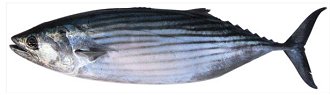
A surface fish which is blue-green above and silvery below with dark narrow bands
extending the entire length of the body. The fins are grey. It's body is
elongated and rounded and very streamlined, and has a single row of small teeth on both
jaws.
Bonito have
moderately large, strong jaws which carry a single row of
relatively small, but distinct, conical teeth. They are
generally dark green to blue on the back, silvery-green on the
sides and silvery-white on the belly. A series of dark,
longitudinal stripes are evident along the fish's upper and
middle flanks. When fresh, these stripes may be broken into
separate dashes by lighter, vertical bars. The stripes of the
bonito are limited to the fish's upper and middle flanks, while
those of the
striped tuna or skipjack (Katsuwonus pelamis) are
found on the lower flanks and belly.
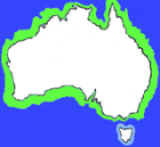
Bonito are found around the entire coast of Australia and feed on small baitfish in
coastal waters. They grow to a maximum weight of about 5 kg.
Bonito are common to southeast coastal
waters of the continent but can be found from Qld. around to W.A. The Australian
Bonito continuously migrates along the east coast from southern Qld. to eastern
Vic., Tas. and S.A. Similar species like the Oriental Bonito (Sarda orientalis)
are found only in the southern coastal seas of W.A. and the Leaping Bonito
[Watson's leaping bonito] (Cybiosarda elegans), a tropical species, can be found
from northern Australia and occasionally further south along the east and west
coasts. They prefer coastal waters attracted mainly to inshore and offshore
reefs, inshore islands, rocky headlands, rocky inshore waters, ocean rocks and
wharves often forming into large schools. The Leaping Bonito is known to
frequent estuaries in search of bait fish populations during the winter months.
Available wild-caught, these free-swimming, marine
fish, from the same family as Tunas, live in schools in open waters over the
continental shelf off the eastern, southern and south-western coasts of
Australia from Cape York (Qld) to Exmouth (WA), with Australian Bonito
found in the east, Oriental Bonito in the west, and
Leaping Bonito in tropical and sub-tropical waters
along both the east and west coasts (venturing into estuaries in winter).
They often school with other Tunas near the coast. Australian
Bonito, which makes up the bulk of the commercial catch, is caught using lines
and purse seines and sold mostly in Sydney. Oriental Bonito is occasionally
trolled off WA and a small quantity of Leaping Bonito is caught of NSW.
They’re generally all marketed simply as Bonito and
look very similar, with blue-green torpedo-shaped bodies fading to silver on the
belly and dark blue-grey stripes covering both upper and lower body; the stripes
on Australian Bonito are almost completely horizontal, while those on Oriental
and Leaping Bonitos are more slanted.
|
 |
 |
How to distinguish from leaping bonito: no spots or
dots on body, narrow stripes on sides.
|
| Scientific Name |
Sarda australis
Sarda orientalis |
| Location |
Australia wide |
| Season |
Available all year |
| Size |
To 102 cm and 5 kg |
| Australian Species Code |
37 441020 |
| Taste, Texture |
Strong taste, firm texture. |
|
Nutritional
Information
For every 100 grams raw product
for Tuna fillet. |
|
Kilojoules |
521 (124
calories) |
|
Cholesterol |
30 mg |
|
Sodium |
37 g |
|
Total fat
(oil) |
0.5 g |
|
Saturated
fat |
33% of total
fat |
|
Monounsaturated fat |
13% of total
fat |
|
Polyunsaturated fat |
54% of total
fat |
|
Omega-3, EPA |
14 mg |
|
Omega-3, DHA |
100 mg |
|
Omega-6, AA |
15 mg |
|
Other
Bonito Links:
TUNA
RECIPES
Exporters of Bonito
Importers of Bonito
Processors of Bonito
Wholesale Suppliers of Bonito
Seafood Agents for Bonito
|
Angling & Fishing for
Bonito:
Bonito can be caught by trolling a small lure just offshore and around offshore reefs. Bonito respond to the same
techniques which take skipjack and mackerel tuna, and also fall
for those employed to target salmon, tailor and kingfish. Boat
anglers sometimes take good hauls by trolling diving minnows
parallel with the shoreline, close to headlands and rock ledges,
or by casting and retrieving lures around "washes" of broken
white-water adjacent to these areas. Land-based anglers also do
well at times by casting and retrieving lures from the ocean
rocks, jetties and breakwalls. In addition to lures and flies,
bonito will attack pilchards and garfish rigged on ganged hooks,
as well as live baits and strip baits or cubes of fish flesh ,
especially when these are free-lined in a berley trail.
|
|
Cooking
Bonito:
The flesh of Bonito is very strong, oily and "meaty" taste. It is
extremely good bait for reef fish.
Usually sold whole, sometimes available as sashimi. In whole
fish look for lustrous skin, firm flesh, and a pleasant, fresh
sea smell. Cooking Methods are to
Pan-fry, bake, grill, barbecue, smoke, raw (sashimi),
pickle. Recipes for Tuna Rolls, Tuna Cheese Melt, Tuna
salad, nutritional information on tuna and easy fish recipes.
Read more about
Cooking Bonito
Tuna and Bonito Recipes
|
|
Commercial Fishing for Bonito:
Australian Bonito is fully fished in Australia.
It is a relatively fast growing species that supports seasonally
significant commercial and recreational catches.
Line methods within the Ocean Trap and Line Fishery account for the majority of
the catch. Listed here are details of companies and contacts that are exporters
of bonito, importers of bonito tuna and processors, wholesale
supply of bonito.
|
|
More links about
Bonito and Australian Bonito Information
New South Wales wild fish program, Australian Bonito
information, Queensland government Dept Agriculture, Fisheries & Forestry
information on Australian Bonito, contacts from Sea-Ex Trade Seafood Industry
directory for importers, exporters, wholesalers, processors of bonito.
|
|