|
|
|
|
|
Directory & Info for Fishing,
Angling, Fishing Tackle, Fishing Guides, Fly Fishing, Bass Fishing,
Sports fishing, Game Fishing....
See >>
Info on All types of
Fishing | Angling | Tackle etc
|
| |
|
Glossary of Fish, Seafood
and Fishing Terms |
|
|
|
Australian Fish Bag Limits and Size Regulations |
|
Photos of Australian Seafood, Fish, Crustaceans &
Cephalopods and Information on each.... |
|
Abalone, Blacklip |
|
Albacore
Tuna |
|
Baler Shell |
|
Barbounia, Tiny |
|
Barracouta |
|
Barramundi |
|
Bass, Sea |
|
Batfish |
|
Batfish, Silver |
|
Blackfish |
|
Boarfish |
|
Bonito Tuna |
|
Bonito, Watson's Leaping |
|
Bream |
|
Bream, Butter |
|
Bream, Slate |
|
Bug, Moreton Bay
(Slipper Lobster) |
|
Bug, Balmain |
|
Butterfish |
|
Calamari,
Southern |
|
Carp, European |
|
Catfish, Blue |
|
Catfish, Lesser Salmon |
|
Cockles |
|
Cod, Bar |
|
Cod, Blue eye |
|
Cod, Coral Rock |
|
Cod, Ghost |
|
Cod, Maori |
|
Cod, Murray
|
|
Cod, Southern Rock |
|
Cod, Spotted |
|
Cod, Tomato |
|
Cod, Wirrah |
|
Cod, Yellow Spotted |
|
Coral Trout |
|
Cowanyoung |
|
Crab, Blue Swimmer |
|
Crab, Champagne |
|
Crab, Giant
|
|
Crab, Mud |
|
Crab, Spanner |
|
Crawfish |
|
Cuttlefish |
|
Dart Fish |
|
Dolphin Fish |
|
Dory, John |
|
Dory, Mirror |
|
Dory, Silver
|
|
Drummer, Southern |
|
Eel, Longfin |
|
Emperor, Red |
|
Emperor, Red Throat |
|
Flathead |
|
Flounder, Small Toothed |
|
Flutemouth, Rough |
|
Frost Fish |
|
Garfish |
|
Gemfish |
|
Goatfish |
|
Grouper |
|
Gurnard, Red |
|
Gurnard, Spotted |
|
Hairtail |
|
Hump Headed
Maori Wrasse |
|
Hussar |
|
Jackass Fish |
|
Jacket, Ocean |
|
Jacket, Sea |
|
Jewfish |
|
Jobfish, Gold Banned |
|
Jobfish, Rosy |
|
Kingfish,
Yellowtail |
|
Latchet Fish |
|
Leatherjacket, Reef |
|
Ling |
|
Lobster - Eastern
Rock |
|
Lobster - Southern Rock |
|
Long Tom |
|
Luderick |
|
Mackeral, Jack |
|
Mackerel, Slimey |
|
Mado |
|
Mahi Mahi |
|
Mangrove Jack |
|
Marlin, Black |
|
Marlin, Blue |
|
Marlin, Striped |
|
Melon Shell |
|
Monkfish |
|
Mono |
|
Moon Fish |
|
Morwong |
|
Morwong, Red |
|
Mullet - Roe |
|
Mullet, Diamond Scale |
|
Mullet, Red |
|
Mullet, Sea |
|
Mullet, Yelloweye |
|
Mulloway |
|
Mussels Black |
|
Mussels Greenlip |
|
Nanygai |
|
Octopus |
|
Orange Roughy |
|
Oreo, Black |
|
Oyster,
Native |
|
Oyster,
Pacific |
|
Oyster, Sydney Rock |
|
Parrot Fish |
|
Parrot Fish (2) |
|
Perch, Ocean |
|
Perch, Saddle Tail Sea |
|
Perch, Silver |
|
Perch, Splendid |
|
Perch, Stripey Sea |
|
Pig Fish |
|
Pike |
|
Pineapple Fish |
|
Prawn, Banana |
|
Prawn, King |
|
Prawn, Red Spot |
|
Prawn, School |
|
Prawn, Tiger |
|
Queenfish, Needleskin |
|
Rainbow Runner |
|
Redclaw Crayfish |
|
Redfish |
|
Ribaldo |
|
Ribbon Fish |
|
Rudder Fish |
|
Salmon, Atlantic |
|
Salmon, Australian |
|
Scad |
|
Scallops, Queensland |
|
Scallops, Tasmanian |
|
Scorpion Fish, Raggy |
|
Shark |
|
Shark Black Tip |
|
Shark, Blue |
|
Shark Bronze Whaler (Dusky) |
|
Shark, Bull |
|
Sharks Fins |
|
Shark, Gummy |
|
Shark, Mako |
|
Shark, School |
|
Shark,
Tiger |
|
Shark,
Whiskery Reef |
|
Shark, White |
|
Shrimp, Mantis |
|
Sicklefish |
|
Silver Biddy |
|
Snapper |
|
Snapper, Big Eye |
|
Snapper, Fry Pan |
|
Snapper, Gold Band |
|
Snapper, King |
|
Snapper,
Red |
|
Snapper, Red Tropical |
|
Sole |
|
Sole, Tongue |
|
Squid, Arrow |
|
Squirrel Fish |
|
Stargazer |
|
Stingray, Butterfly |
|
Stripey Sea
Perch |
|
Surgeonfish, Sixplate Sawtail |
|
Sweetlip, Slatey |
|
Sweetlip, Yellow |
|
Swordfish |
|
Tailor |
|
Tarwhine |
|
Tilefish,
Pink |
|
Trevally, Big Eye |
|
Trevally, Golden |
|
Trevally, Silver |
|
Triple Tail |
|
Trout |
|
Trumpeter, Striped |
|
Tuna,
Albacore |
|
Tuna, Bigeye |
|
Tuna, Bluefin |
|
Tuna, Longtail |
|
Tuna, Skipjack |
|
Tuna, Striped |
|
Tuna, Mackerel |
|
Tuna, Yellowfin |
|
Venus Tusk Fish |
|
Whiting, Sand |
|
Whiting, School |
|
Wrasse |
|
Yabby,
Freshwater Crayfish |
|
Yellowtail |
|
FULL LIST of Fish &
Seafood |
|
Beche De Mer
(Sea Cucumber - Trepang) |
|
Amberfish |
|
Blackfish |
|
Black Teatfish |
|
Brown Sandfish |
|
Curryfish |
|
Elephants Trunks fish |
|
Greenfish |
|
Lollyfish |
|
Pinkfish |
|
Prickly Redfish |
|
Sandfish |
|
Stonefish |
|
Surf Redfish |
|
White Teatfish |
|
|
|
Commercial Seafood
Directory |
|
Sea-Ex Seafood, Fishing, Marine
Directory |
|
Aquaculture Directory |
|
Commercial Fishing |
|
Seafood Information by
Country |
|
Fish Photos & Fish
Information |
|
Interesting Fish Facts & Trivia |
|
Country Directories |
|
Thailand Business
Directory |
|
Seafood
|
|
Wholesale Seafood
Suppliers Australia |
|
Wholesale Seafood
Suppliers International |
|
Retail Seafood
Sales |
|
Seafood
Restaurants |
|
Seafood
Recipes |
|
Seafood
Information |
|
Seafood
Industry Resources |
|
Sea-Ex Seafood & Fishing
Directory -
Home Page |
|
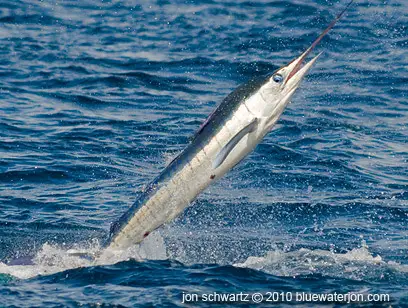
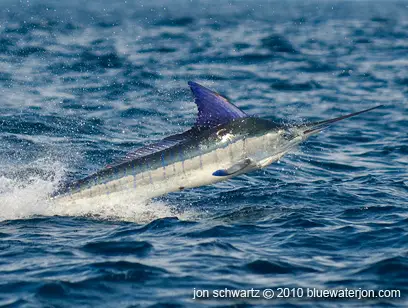
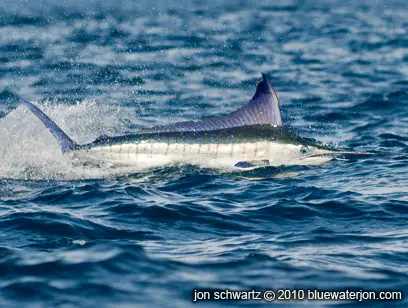
Striped Marlin (Tetrapturus
audax) Photographs
and Information
|
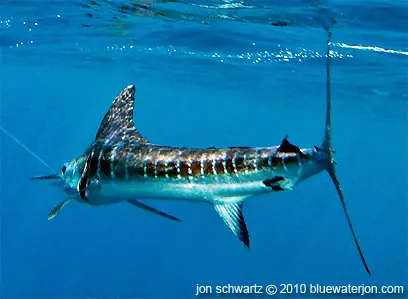
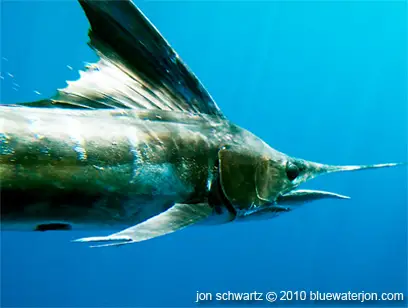
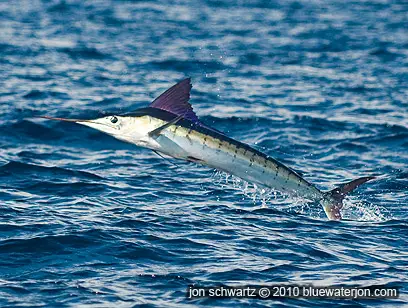
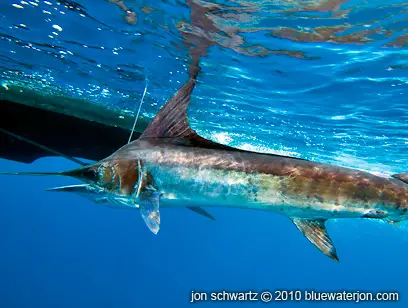
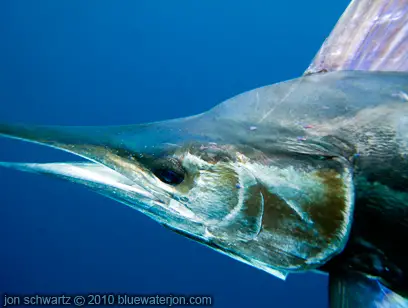
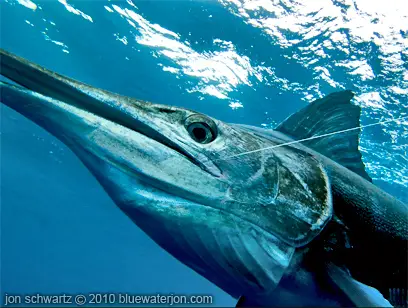
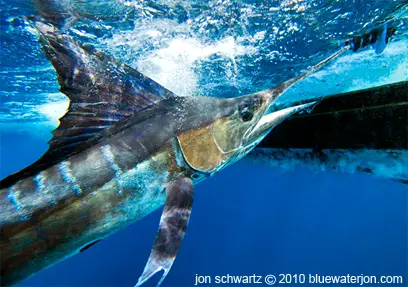
Striped Marlin: Dorsal spines (total): 0 - 0; Dorsal soft rays (total): 42 - 48; Anal spines: 0; Anal soft rays: 18 – 24. Body elongated and compressed; upper jaw produced into a robust and medium sized beak; two dorsal fins, the height of the first greater than the greatest depth, short anteriorly, taller in the middle, then becoming shorter posteriorly; pectoral fins falcate and flexible, with 18 to 22 rays; body densely covered by small, embedded scales with 1 or 2 bluntish points; back dark blue; belly silvery; membrane of first dorsal fin blue black without dark spots; flanks with about 20 bluish stripes (Ref. 55763). Blue-black above and silvery white below, with about 15 rows of cobalt-colored stripes; 1st dorsal fin dark blue; other fins dark brown, sometimes with a tinge of dark blue; anal fin bases with a tinge of silvery white.
Epi-pelagic and oceanic species, usually found above the thermocline. Generally inhabit cooler water than either black (Makaira indica) or blue marlin (M. mazara) (Ref. 43). Most dominant and widely distributed of all billfishes. Their abundance increases with distance from the continental shelf (Ref. 6390). Usually seen close to shore only where deep drop-offs occur (Ref. 6390). Mostly solitary, but form small schools by size during the spawning season (Ref. 9987). They are usually dispersed at considerably wide distances. Feed on fishes, crustaceans and squids. Also caught with the harpoon. The flesh is the best among billfishes for sashimi and sushi. Marketed mostly frozen, sometimes fresh (Ref. 43); also smoked and frozen
|
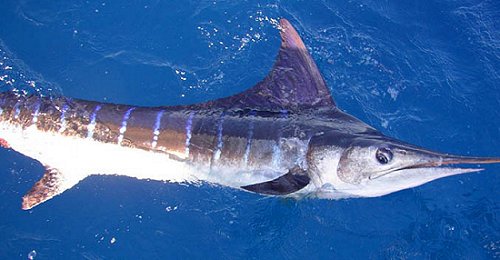 |
Striped Marlin (Tetrapturus audax)
French: Marlin Raye
German: Gestreifter Marlin
Italian: Pesce Lancia Striato
Spanish: Marlin Rayado
Japanese: Makijiki
Hawaii names: A`u
|
| Scientific Name |
Tetrapturus audax |
| Location |
Indo-Pacific: tropical, subtropical and temperate waters. Highly migratory species. |
| Size |
420 cm TL (male/unsexed; max. published weight: 440.0 kg |
|
Nutritional
Information
For every 100 grams raw product
for Marlin fillet. |
|
Kilojoules |
512 (122
calories) |
|
Protein: |
19.4 g |
|
Cholesterol |
180 mg |
|
Sodium |
102 g |
|
Total fat
(oil) |
7.7 g |
|
Saturated
fat |
33% of total
fat |
|
Monounsaturated fat |
37% of total
fat |
|
Polyunsaturated fat |
30% of total
fat |
|
Omega-3, EPA |
371 mg |
|
Omega-3, DHA |
541 mg |
|
Omega-6, AA |
423 mg |
|
|
Angling for
Striped Marlin:
Because of their large size and strength, catching marlin
demands the use of quality tackle kept in good repair. Trolling
with lures and trolling with baits - either live or dead - and
fishing at anchor or from a drifting boat with baits, live or
dead, accounts for over 90 per cent of the marlin taken in our
waters. The best lures are Konahead-style skirted heads that run
freely on the leader or trace. A lure of this pattern with a
flat or slightly angled head, called a "pusher", trolled a
between 7 and 12 knots behind a moving boat, is a proven method
of attracting marlin. Suitable live and dead baits range from 15
centimetre yellowtail scad or mullet, through 3 kg striped tuna
and 5 kg mackerel tuna to whole 15 kg Spanish mackerel! The
choice of baits depends on the location, the strength of tackle,
and the ambitions of the angler. Rigging baits for trolling -
especially dead baits, which are pulled fairly quickly - is an
acquired skill. Many fine marlin have also been taken on live
baits of tuna, bonito, salmon or kingfish hooked through the top
jaw or bridle rigged and trolled at walking pace near a current
line or patch of bait. In lure fishing, the strike is
instantaneous, as the drag is usually set at about a quarter to
a third of the line's breaking strain. The hook either punches
home or misses in the instant of the strike. However, if taken
on a bait, marlin should be allowed to turn and run with the
bait against minimal resistance for anything between one and 30
seconds before being struck.
Striped Marlin: How
to Catch and Release Big Fish
By Jon Schwartz
www.bluewaterjon.com
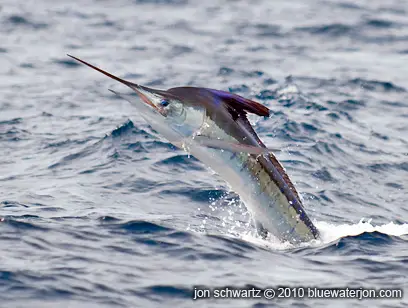
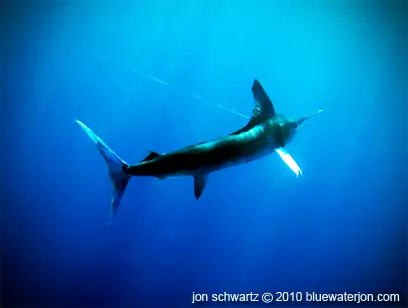 Striped
Marlin on the Pacific Coast of North America aren’t as big as blues and black
marlin, and are only half as big as striped marlin get in New Zealand, but
when fought on moderate tackle (30-40 pound test), they put up a tremendous
fight and jump plenty. Most I’ve seen run between 100-150 pounds Striped
Marlin on the Pacific Coast of North America aren’t as big as blues and black
marlin, and are only half as big as striped marlin get in New Zealand, but
when fought on moderate tackle (30-40 pound test), they put up a tremendous
fight and jump plenty. Most I’ve seen run between 100-150 pounds
Their stripes are more pronounced than any other species of marlin, and they can
even reverse their pattern, from being dark stripes on light skin, to light
stripes on dark skin. Their stripes become more pronounced when they are
agitated and on the hunt. When they are tired and exhausted, they lose their
colors and stripes.
One popular method of sport fishing involves the use of circle hooks with live
bait. The hook ends up catching in the corner of the mouth rather than in the
gut and promotes healthier releases. Mouth hooked fish fight better and jump
more. Other anglers troll skirted lures with j-hooks. Some use two hooks, but
some of the world’s most successful captains that I have ridden with only use
one hook, and one hook certainly increases the odds of a quicker and safer
release for the fish and the person charged with releasing it.
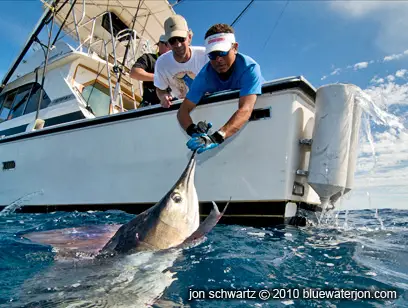
While some choose to hoist the fish into the boat to pose with it, it’s better
for the fish to remain in the water. Removing them from the water creates undue
stress. I have swam with many marlin and I can personally attest to the fact
that fish that have been removed from the water for a glory shot take longer to
recover, and some will not recover. Scientists, seasoned captains and anglers,
and conservation organizations such as The Billfish Foundation also
contend that their protective slime is removed when they are handled, and it’s
nearly impossible to bring a 150+ pound fish aboard and properly support them.
In addition, one has to tire the fish out more to make them s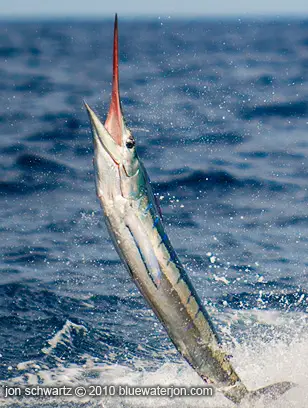 till
enough to handle and bring aboard. till
enough to handle and bring aboard.
Often a fish is brought aboard because the captain and
mate assume that the angler wants it to happen; the captain and mates I know
would actually rather leave it in the water, but they feel pressure to bring it
aboard to please the angler. If you can resist the temptation to have your
marlin brought aboard, tell the mate and captain in advance that you’d rather
they keep the fish in the water and release it in better shape.
To best protect marlin and ensure that they swim away in good health, it’s best
to fight them on sufficiently stout tackle, and use fighting harnesses to
maximize your leverage. These help reduce fight time and enable the angler to
bring the fish to boat side for a quicker release. This might mean using 30-40
pound tackle for striped marlin in the 150 pound range, 50 pound tackle for
marlin up to 250 pounds, 60 pound tackle for fish between 250 and 400 pounds, 80
pound tackle for fish 400-600 pounds, and 130 pound tackle for anything bigger.
Your captain and mate will be able to tell you the size of fish that you will
likely encounter in an area at a certain type of year. That being said, of
course a 1000 pound marlin can come up and engulf a bait rigged on 50 pound
test, but that’s rare. If you’re like me, you’ll have more fun rigging right for
the fish you’re likely to encounter.
If you’d like more “face time” with your marlin, it may be possible to do so
without removing the fish from the water. The fish can be brought alongside the
boat while the boat is still moving slowly in gear, and if the fish remains
calm, the mate sometimes can hold the fish’s bill close to the water’s surface,
so that water continues to flow through the fish’s gills. Once you’ve got your
face time, they simply release the bill and the fish swims away in great shape.
|
|
Cooking
Striped
Marlin:
Striped Marlin -
High fat, Low moisture, medium to firm
texture.
Marlin of all sizes are fair to good table fish, although the
relatively high mercury content of their flesh precludes them
from some commercial markets. The striped marlin, with its
pinkish orange flesh, is generally considered to be much tastier
than either of the other species mentioned.
Billfishes swordfish
and striped marlin are becoming more popular food fishes in
Australia. While grouped together under the name billfish ,
they have distinctive textures and flavours.
Swordfish is often described as the most meat-like of all
fishes. The steaks have very high oil content, with a dense,
meaty texture and a slightly sweet taste. The flavour is not
overpowering, allowing for stronger flavours to be used in
its preparation. An interesting way to prepare swordfish is
to poach steaks in a strong fish stock, infused with olives.
Dress with dried red capsicum, dried tomatoes, olives and
oven-roasted garlic, and serve on a bed of angel hair pasta
with a mash of salsify. Swordfish is also suited to
grilling, frying and baking.
Striped marlin flesh is darker and more strongly flavoured.
It is firmly textured and quite low in moisture. Most suited
to grilling, marlin can also be prepared by baking,
poaching, shallow frying or smoking, or eaten raw as
sashimi. Simply sear marlin on a hot grill and serve with a
citrus and pecan salsa. Or you may wish to add spicier Thai
flavours. Try char-grilling but keep the centre rare to
avoid dryness. Marlin is delicious smoked and is a common
entree.
Microwave Cooking
Times for Fish
- Fish fillets – 5 minutes per 500g on medium-high, +50
seconds more for thicker fillets, or until flesh flakes
- Whole fish - Large – 6 minutes/750g on medium
- Whole fish – Small – 3-4 minutes on medium
|
|
Commercial Fishing for Striped Marlin: Wild caught
Recovery Rate
Steaks: 60% from headed and gutted striped marlin and 70% from headed and gutted
swordfish.
More links about
Striped Marlin and Marlin
BILLFISH TAGGING
Billfish, including sailfish, swordfish
and marlin, are among the most
sought-after gamefish on the planet.
Exceedingly beautiful and athletic, the
largest of these species can reach
lengths over 16 feet, and weights of
nearly 2,000 pounds. Despite their
popularity among sport anglers, however,
much remains to be learned about the
basic biology of these fishes.
Tagging
studies have demonstrated that they can
travel great distances – with one record
of an Atlantic blue marlin traveling
from off the coast of Delaware to the
island of Mauritius off the southeast
coast of Africa in the Indian Ocean – a
voyage of 9,254 miles. Researchers from
the TRCC, utilizing both pop-up
satellite tags and fin-mounted SPOT
tags, have also demonstrated these
animals’ ability to cover great
distances quickly – with several tagged
blue marlin covering distances of over
2,000 nautical miles in just a few
months.
This information is from
The Tuna Research and Conservation
Center
|
|