|
|
|
|
|
Directory & Info for Fishing,
Angling, Fishing Tackle, Fishing Guides, Fly Fishing, Bass Fishing,
Sports fishing, Game Fishing....
See >>
Info on All types of
Fishing | Angling | Tackle etc
|
| |
|
Glossary of Fish, Seafood
and Fishing Terms |
|
|
|
Australian Fish Bag Limits and Size Regulations |
|
Photos of Australian Seafood, Fish, Crustaceans &
Cephalopods and Information on each.... |
|
Abalone, Blacklip |
|
Albacore
Tuna |
|
Baler Shell |
|
Barbounia, Tiny |
|
Barracouta |
|
Barramundi |
|
Bass, Sea |
|
Batfish |
|
Batfish, Silver |
|
Blackfish |
|
Boarfish |
|
Bonito Tuna |
|
Bonito, Watson's Leaping |
|
Bream |
|
Bream, Butter |
|
Bream, Slate |
|
Bug, Moreton Bay
(Slipper Lobster) |
|
Bug, Balmain |
|
Butterfish |
|
Calamari,
Southern |
|
Carp, European |
|
Catfish, Blue |
|
Catfish, Lesser Salmon |
|
Cockles |
|
Cod, Bar |
|
Cod, Blue eye |
|
Cod, Coral Rock |
|
Cod, Ghost |
|
Cod, Maori |
|
Cod, Murray
|
|
Cod, Southern Rock |
|
Cod, Spotted |
|
Cod, Tomato |
|
Cod, Wirrah |
|
Cod, Yellow Spotted |
|
Coral Trout |
|
Cowanyoung |
|
Crab, Blue Swimmer |
|
Crab, Champagne |
|
Crab, Giant
|
|
Crab, Mud |
|
Crab, Spanner |
|
Crawfish |
|
Cuttlefish |
|
Dart Fish |
|
Dolphin Fish |
|
Dory, John |
|
Dory, Mirror |
|
Dory, Silver
|
|
Drummer, Southern |
|
Eel, Longfin |
|
Emperor, Red |
|
Emperor, Red Throat |
|
Flathead |
|
Flounder, Small Toothed |
|
Flutemouth, Rough |
|
Frost Fish |
|
Garfish |
|
Gemfish |
|
Goatfish |
|
Grouper |
|
Gurnard, Red |
|
Gurnard, Spotted |
|
Hairtail |
|
Hump Headed
Maori Wrasse |
|
Hussar |
|
Jackass Fish |
|
Jacket, Ocean |
|
Jacket, Sea |
|
Jewfish |
|
Jobfish, Gold Banned |
|
Jobfish, Rosy |
|
Kingfish,
Yellowtail |
|
Latchet Fish |
|
Leatherjacket, Reef |
|
Ling |
|
Lobster - Eastern
Rock |
|
Lobster - Southern Rock |
|
Long Tom |
|
Luderick |
|
Mackeral, Jack |
|
Mackerel, Slimey |
|
Mado |
|
Mahi Mahi |
|
Mangrove Jack |
|
Marlin, Black |
|
Marlin, Blue |
|
Marlin, Striped |
|
Melon Shell |
|
Monkfish |
|
Mono |
|
Moon Fish |
|
Morwong |
|
Morwong, Red |
|
Mullet - Roe |
|
Mullet, Diamond Scale |
|
Mullet, Red |
|
Mullet, Sea |
|
Mullet, Yelloweye |
|
Mulloway |
|
Mussels Black |
|
Mussels Greenlip |
|
Nanygai |
|
Octopus |
|
Orange Roughy |
|
Oreo, Black |
|
Oyster,
Native |
|
Oyster,
Pacific |
|
Oyster, Sydney Rock |
|
Parrot Fish |
|
Parrot Fish (2) |
|
Perch, Ocean |
|
Perch, Saddle Tail Sea |
|
Perch, Silver |
|
Perch, Splendid |
|
Perch, Stripey Sea |
|
Pig Fish |
|
Pike |
|
Pineapple Fish |
|
Prawn, Banana |
|
Prawn, King |
|
Prawn, Red Spot |
|
Prawn, School |
|
Prawn, Tiger |
|
Queenfish, Needleskin |
|
Rainbow Runner |
|
Redclaw Crayfish |
|
Redfish |
|
Ribaldo |
|
Ribbon Fish |
|
Rudder Fish |
|
Salmon, Atlantic |
|
Salmon, Australian |
|
Scad |
|
Scallops, Queensland |
|
Scallops, Tasmanian |
|
Scorpion Fish, Raggy |
|
Shark |
|
Shark Black Tip |
|
Shark, Blue |
|
Shark Bronze Whaler (Dusky) |
|
Shark, Bull |
|
Sharks Fins |
|
Shark, Gummy |
|
Shark, Mako |
|
Shark, School |
|
Shark,
Tiger |
|
Shark,
Whiskery Reef |
|
Shark, White |
|
Shrimp, Mantis |
|
Sicklefish |
|
Silver Biddy |
|
Snapper |
|
Snapper, Big Eye |
|
Snapper, Fry Pan |
|
Snapper, Gold Band |
|
Snapper, King |
|
Snapper,
Red |
|
Snapper, Red Tropical |
|
Sole |
|
Sole, Tongue |
|
Squid, Arrow |
|
Squirrel Fish |
|
Stargazer |
|
Stingray, Butterfly |
|
Stripey Sea
Perch |
|
Surgeonfish, Sixplate Sawtail |
|
Sweetlip, Slatey |
|
Sweetlip, Yellow |
|
Swordfish |
|
Tailor |
|
Tarwhine |
|
Tilefish,
Pink |
|
Trevally, Big Eye |
|
Trevally, Golden |
|
Trevally, Silver |
|
Triple Tail |
|
Trout |
|
Trumpeter, Striped |
|
Tuna,
Albacore |
|
Tuna, Bigeye |
|
Tuna, Bluefin |
|
Tuna, Longtail |
|
Tuna, Skipjack |
|
Tuna, Striped |
|
Tuna, Mackerel |
|
Tuna, Yellowfin |
|
Venus Tusk Fish |
|
Whiting, Sand |
|
Whiting, School |
|
Wrasse |
|
Yabby,
Freshwater Crayfish |
|
Yellowtail |
|
FULL LIST of Fish &
Seafood |
|
Beche De Mer
(Sea Cucumber - Trepang) |
|
Amberfish |
|
Blackfish |
|
Black Teatfish |
|
Brown Sandfish |
|
Curryfish |
|
Elephants Trunks fish |
|
Greenfish |
|
Lollyfish |
|
Pinkfish |
|
Prickly Redfish |
|
Sandfish |
|
Stonefish |
|
Surf Redfish |
|
White Teatfish |
|
|
|
Commercial Seafood
Directory |
|
Sea-Ex Seafood, Fishing, Marine
Directory |
|
Aquaculture Directory |
|
Commercial Fishing |
|
Seafood Information by
Country |
|
Fish Photos & Fish
Information |
|
Interesting Fish Facts & Trivia |
|
Country Directories |
|
Thailand Business
Directory |
|
Seafood
|
|
Wholesale Seafood
Suppliers Australia |
|
Wholesale Seafood
Suppliers International |
|
Retail Seafood
Sales |
|
Seafood
Restaurants |
|
Seafood
Recipes |
|
Seafood
Information |
|
Seafood
Industry Resources |
|
Sea-Ex Seafood & Fishing
Directory -
Home Page |
|
Blue or
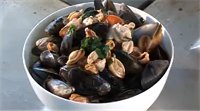
Black Mussels (Mytilus galloprovincialis & Mytilus edulis) Photographs
and Information
|
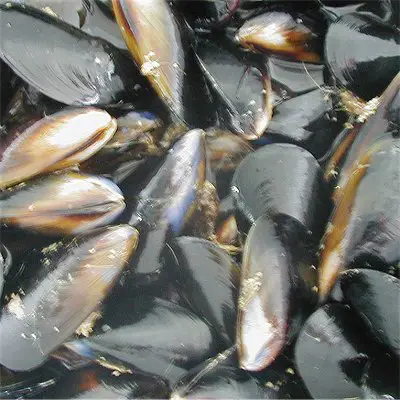
Blue mussels (Mytilus Edulis) have a
smooth, bluish-black shell. Wild blue mussels and tend to live in coastal
estuaries or near shorelines. They often grow in clumps, attaching themselves to
rocks or to each other by means of sticky filaments, sometimes referred to as a
"beard". They are typically harvested by hand at low tide. In the North
Atlantic, blue mussels are often grown using a variety of methods, but most
methods share common traits, usually providing some means for mussels to anchor
and live above the sea floor.
Blue mussels inhabit a wide range of estuarine and marine environments. They
attach to rocks, jetties and piers and sometimes form dense beds on sandy flat substrates.
They can be found from the low tide level to a depth of 10 metres, and they prefer
sites with significant water movement.
Blue mussels have a minor spawning period in June, followed by a second, extended
spawning period from August to January. Spawning occurs at water temperatures of
14°C. Blue mussels are "broadcast spawners" releasing eggs and sperm
simultaneously into the water with fertilisation taking place in open water.
The fertilised eggs are planktonic, averaging 0.07mm in diameter and develop into
unshelled larvae within a day.
Larvae are free swimming and the planktonic stage can last from 2 weeks to several
months, although most larvae settle 3-4 weeks after spawning.
Blue mussels are filter feeders, straining plankton from the water. They are
preyed on by crabs, starfish, leatherjackets, pufferfish and flat worms.
Did you know? he colour of the mussel meat varies slightly - the girls are pink and the boys are
paler !!
|
 |
 |
MUSSEL MYTH: Cooked closed mussels should not be eaten
- Unopened mussels are just a nuisance to open because the mussel node has not
released.
There is no scientific or microbiological reasoning to suggest they should not
be eaten. Don't waste them!
|
| Scientific Name |
Mytilus galloprovincialis
and
Mytilus edulis |
| Location |
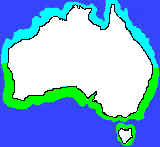
Southern Coast of Australia |
| Season |
July to February |
| Size |
4.5-5.0 cm |
| Australian Species Code |
00 652001 |
| Taste, Texture |
- |
|
Nutritional Information
For every 100 grams raw product
for Blue Mussel meat. |
|
Kilojoules |
374 (89
calories) |
|
Cholesterol |
22 mg |
|
Sodium |
270 mg |
|
Total
fat (oil) |
1.7 g |
|
Saturated fat |
35% of
total fat |
|
Monounsaturated fat |
20% of
total fat |
|
Polyunsaturated fat |
45% of
total fat |
|
Omega-3,
EPA |
153 mg |
|
Omega-3,
DHA |
166 mg |
|
Omega-6,
AA |
13 mg |
|
|
|
Some information on Cultured Mussels in Australia: Mussels are one of the most nutritious, convenient and value-for-money
seafood delicacies available. Today, mussels are grown at 20 of the lease sites
granted in Victoria's Port Phillip Bay.
The mussels are grown on ropes in clean, flowing ocean currents and harvested at their
peak condition. Unlike inferior dredged mussels dragged out of the mud at the
bottom, Cultured Mussels are suspended metres above the seabed and are clean and free from
sand and grit - so clean they need very little preparation.
A small pea crab is
sometimes found inside the blue mussel. It is not
harmful to humans, nor does its presence mean that
the mussel is dead or in poor condition.
Farmed mussels usually
have thinner shells than wild-caught mussels because
they are usually farmed in relatively calm waters.
Some interesting history of
Mussel Farming:
Once popular as snacks that could
be harvested free or purchased cheaply (and known as
‘poor man’s Oysters’), these filter feeders became a
casualty of the Industrial Revolution as people
became concerned about the quality of the water in
which they were growing wild. Mytiliculture,
as the cultivation of Mussels is known, was however
one of the earliest forms of aquaculture, dating to
at least 13th century France.
A story tells of an Irishman shipwrecked on the
western coast of France near La Rochelle who made a
chance discovery that poles he erected in the
mudflats to support nets for catching birds became a
breeding ground for Mussels. So he drove in more
stakes, closer together, and joined them with
bundles of branches (‘bouches’) at low tide level
and turned his hand to mytiliculture. The
Mussels probably tasted better than the birds
anyway! The process has been refined a little, but
Mussels are still grown in France in virtually the
same way on wooden hurdles called ‘bouchot’.
|
|
Cooking
Mussels:
The byssal threads,
which mussels use to attach themselves to the
substrate, should be removed before cooking.
MUSSELS are high in protein and minerals and low in calories and fat.
Mussels
can be served cooked or cold, as part of a seafood
platter, dipped into a spicy sambal and chilli
sauces, added to paellas or, at the last minute,
fish soups. Large mussels served in the half shell
can also be stuffed and grilled.
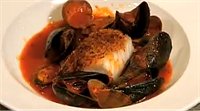
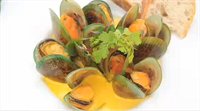
Mussel Recipes
Blue Mussels are sold live. Look
for brightly coloured, intact, lustrous shells, that are closed or close when
tapped or gently squeezed, and a pleasant fresh sea smell. Tiny crabs are
sometimes found inside Mussels, they are harmless and do not indicate any
problem with the Mussel.
Storing
Live shellfish should be consumed as soon as possible after purchase. Place
Mussels in a container, cover with a damp cloth and keep in the warmest part of
the refrigerator, usually the crisper (optimum 5°C), ensuring that the covering
remains damp. Before cooking, discard any shells that are open and don’t close
when tapped or gently squeezed (you may need to give them 10-20 minutes out of
the fridge to warm up first). Cooked Mussels can be removed from their shells
and frozen for up to 3 months (below -18ºC) then thawed in the refrigerator and
used in soups or salads (do not recook as they’ll become tough).
Cooking
Mussels need very little cooking and are ready
virtually as soon as the shells open.
If Mussels are being
served in the shell, remove the beards before cooking by
holding shells firmly closed and sharply tugging beards away
from the pointy end of the shell; if Mussels are being
removed from shells, cook with beards attached, they are
easy to pull off the cooked Mussels once they’re removed
from their shells. Lightly scrub shells with a plastic
scourer to remove any sediment or barnacles. They have a
rich, strong flavour, high oiliness and moist, juicy,
medium-textured flesh. All of the flesh inside the shell is
edible, females tend to be more orange in colour, whereas
males are paler.
Mussels yield
an average of 30% meat, so allow around 600g of whole shells
per person as a main course. Mussels work well with bacon,
breadcrumbs, butter, celery, chilli, citrus, fennel, garlic,
herbs (coriander, dill, lovage, parsley, French tarragon),
mayonnaise, olive oil, onion, pepper, Pernod, potatoes,
saffron, tomato, white wine. They lend themselves to a wide
range of cooking styles, including steaming, poaching,
deep-frying, stir-frying, baking, grilling, barbecuing (in
the shell), smoking and pickling. Some connoisseurs even
like the very fresh ones raw (sashimi), though this is rare.
Due to their similarities, Blue Mussels often make a good
substitute for Vongole, Pipis and other clams. The firm
flesh works particularly well in soups, curries and
stir-fries and they are often seen in cream or tomato
sauces, fried, sautéed, au gratin (covered with herb and
garlic butter and breadcrumbs and grilled until bubbling),
in omelettes, soups, pasta, paella and salads.
|
|
Commercial Fishing for Mussels:
Blue mussels are an important commercial fishery. There are only small sectors
still harvesting wild mussels. Most mussels are aquacultured, grown using long line
methods, with sprat collected via natural settlement. All farmed product is sold
live and whole in the shell.
Mussels (or black
Mussels), as they are the only commercial species of Mussel sold
in quantity in Australia. They grow wild in intertidal waters to
depths of around 20m, often in dense clumps, attached by coarse
rope-like ‘beards’ (byssal threads) to exposed reefs, rocks and
jetty pylons, and were traditionally harvested by divers off
southern NSW, Victoria, SA and southern WA.
Wild Mussel harvests have been in decline, however, since
aquaculture commenced in NSW in 1976, and now all Blue Mussels
sold commercially are farmed. They are grown in southern NSW
(around Eden), Victoria, Tasmania, SA and southern WA in clean,
sheltered water 5-20m deep. During spawning, Mussels produce up
to 8 million tiny eggs (0.07mm in diameter), which float on the
currents for up to 3 months before settling.
The tiny immature Mussels (spat) are collected on ropes (mainly
from the wild, although some are produced in hatcheries in
Tasmania) and raised in long ‘socks’ (to protect them from
predators) suspended from horizontal ropes attached to buoys to
keep them immersed (known as subtidal suspended culture). They
are harvested at 12-18 months, when they average 6-9cm and
25-40g (although they can grow to almost 13cm and 50g) and are
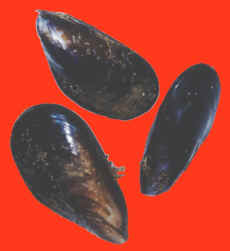
available year round. The smooth dark, wedge-shaped shell
(usually bluey-purple to black, but occasionally browny-grey,)
with a bluish-white interior is easily distinguished from other
bivalve molluscs such as Oysters, Pipis and Vongole.
Commercial
Fishing & Aquaculture of Mussels:
Suspension aquaculture
systems are the most common method of growing blue mussels.
Typically, farms employ a network of horizontal lines suspended
in the water from buoys from which ropes or lines called
droppers are hung. The larvae or spat attach themselves to the
droppers and grow. Blue mussels reach market sizes in 1-2 years.
They feed by filtering 10-15 gallons of water a day.
The traditional French 'bouchot' method of mussel
culture originates from the 13th century. According to
legend, an Irish traveler was shipwrecked on the Mont Saint
Michel Bay when he accidentally discovered the habit of mussels
to aggregate on ropes and fatten remarkably . The culture method
was named by a combination of two words in the Irish of the
time: Bout=fence, Chot=Wood. The bouchot method of mussel
farming is implemented on wooden poles which are placed upright
into the sea bed in the low inter-tidal region.
Mussels in Galicia (Spain) are farmed using "Batea" -
a floating platform made of eucalyptus beam fastened on top
of barrels or floaters and anchored to the sea bed by means of
concrete block called "muertos" (dead). In 2010, there were more
than 3,300 bateas in the estuary waters of Galicia, producing
almost half of the EU production.
Exporters, Importers & Processors, Wholesale & Agents of Mussels
from Trade-Seafood.com
More links about
Albacore Tuna and Tuna Information
Western Australian Fisheries - Publications and information
on popular freshwater and saltwater aquaculture
species: Ornamental Fish, Silver Perch, Black Bream, Red Claw,
Trout, Yabbys, Marron, Mussels, Pearls, Western Rock Lobster,
Trochus, Abalone, Barramundi, Fin Fish, Prawns.
Australian Government - Australian Bureau of Agricultural and Resource Economics
and Sciences (PDF file) - Australian Fisheries Statistics 2010/2011
|
|