Sea-Ex Seafood
Trade Directory
Directory of Seafood
Companies by Species
Imported, Exported, Wholesale, Processors &
Producers
Click Here for
SEAFOOD DIRECTORY
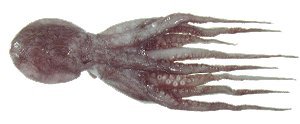
Octopus are cephalopods with 8 arms. They have no fins.
Octopus inhabit seagrass beds in bays and coastal waters as well as
coastal reefs.
All octopus have a short life cycle in which each female produces 1 egg
mass and dies soon after the eggs have hatched. They are solitary animals and are
often very active during daylight. They live for approx. 18 months.
Octopus appeared approx. 500 million years ago.
By day, when hungry fishes prowl, an octopus hides in its den: under rocks, in holes or
empty shells or shallow depressions on the seafloor. But under the cover of twilight, an
octopus turns hunter, stalking crabs, shrimp and snails.
When it finds prey, the octopus pounces. Holding on with suckers, it cracks the shell
with its beak and injects poison. It usually returns home to eat the meal.
An octopus explores with its tentacles and suckers. The suckers can taste the
difference between sweet, sour and bitter, and can feel if something's rough or smooth.
To grab a crab, an octopus draws up the centers of its suckers to create a vacuum.
Octopuses have tremendous gripping power. It takes 18kg of pull to release the grip of a
1.4kg octopus.
Octopuses are
major predators of
rock
lobsters and fishing was initially based
on a by-catch in commercial rock lobster fisheries. Some targeted
octopus fisheries now exist and octopuses trawled incidentally
in prawn and finfish fisheries in northern Australia are also
retained and sold.
Did you know?
Octopus appeared approx. 500 million years ago.
Scientific Name
Octopus Species
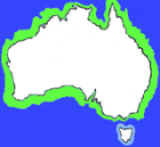
Location
Australia wide
Season
All year round
Size
0.3 to 9 kg
Australian Species Code
00 601001
Taste, Texture
-
Nutritional Information
For every 100 grams raw product
for Octopus.
Kilojoules
328 (78
calories)
Cholesterol
104 mg
Sodium
285 mg
Total fat
(oil)
1.0 g
Saturated
fat
42% of total
fat
Monounsaturated fat
7% of total
fat
Polyunsaturated fat
51% of total
fat
Omega-3, EPA
71 mg
Omega-3, DHA
289 mg
Omega-6, AA
16 mg
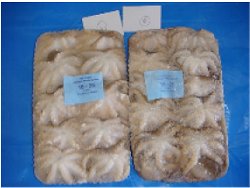
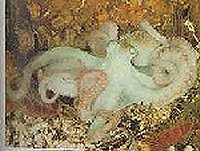
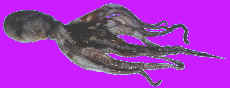
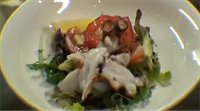
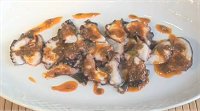
Octopus Photos:
Video on Octopus facts,
very humorous but some interesting facts about octopus:
Octopus Facts from the
video:
The name "octopus" comes from the Greek work for 8 footed,
because it has 8 arms. There are 2 major orders of octopus - the
Serena and Inserena. The Serena have 2 small fins, a small
internal shell and lots of little cilia next to their suckers.
The other order of octopus is inserena - no internal shell and
no fins. Octopus are amazing - they have color and texture
changing capabilities. The most remarkable is the octopus's
intelligence, they are the most intelligent of all of the
invertebrates.
Octopus can learn and remember complex tasks like opening
child-proof jars and moving through mazes. They have evolved a
very different intelligence than ours. Unlike our intelligence
which is mainly centralised in our head, the octopus has
distributed intelligence. 3/5's of its neurons are located in
its arms - in a way each of its arms has a mind of its own!
These arms are so capable, that even when severed, they will
continue to search for and capture food and then try to bring
the food to a non-existent mouth. Some octopus with actually
remove one of their arms when threatened and let it wriggle away
to confuse the predator. Each arm is equipped with 250 suction
cups. Each one with the ability to rotate and grasp
independently. The suction cups also contain sensory receptors
which enable it to taste and smell what it touches.
Inside the octopus mouth is a beak, the only hard part of the
octopus. The means that the octopus can move through any hole
that is larger than its beak. The tentacles guide food towards
its beak where venomous saliva incapacitates prey before eating.
When it comes to moving the octopus has a variety of options. It
can crawl or use a water jet called a siphon, or it can "walk"
on two of its tentacles. Some scientists have argued that 2 of
its arms should be called legs. Octopus can even move on land
effectively.
Although the eight arms of the octopus seems identical, one of
the males arms is actually a hectocotylis which functions like a
penis. The male transfers sperm to the female via this arm and
deposits the sperm in 2 ways, either by inserting it into a hole
in her mantle, or tearing it off and presenting to to her for
later use! When the female has fertilised her eggs, she goes to
an underwater crevasse and attaches her eggs to the roof. She
will stay with the eggs, gently fanning water over them until
they hatch. She slowly starves to death, by the time the eggs
hatch, she is dead.
Angling for Octopus | Catching
Octopus:
Cooking Octopus
:
Cooking and Preparing Octopus:
Octopuses have an enjoyable mild flavour,
with a texture similar to that of squids, though more dense.
Prepare the fresh octopus for cooking. Cut
off the eyes and beak. Use the opening to turn the head inside
out and remove the ink sac and intestines. Rinse the entire
octopus under warm running water for one minute.
Cook octopus quickly over a high heat or simmer slowly.
Marinating will help to tenderise the flesh and strengthen the
flavour for enhanced results when cooking quickly.
Octopus is tough at the best of times. Among
octopus-cooking cultures, there are all sorts of recommendations
for tenderizing it.
Greek Style is to beat it against a smooth
rock or throw it onto a cement path 100 times, then rub it on
the rock in a circular movement sprinkling it with seawater
until the tentacles become curly or the membrane between them
can be easily torn. Many Octopus that you buy prepared have been
placed in a cement mixer with rocks for several hours!
Spanish Style is to dip it into boiling water
three times, then cook it in a copper pot.
Italian cooks boil it with a cork (it is
believed that enzymes in the cork tenderise the octopus)
How to Clean an Octopus Sydney Fish Market takes you through how to clean an Octopus
ready for cooking.
Commercial Fishing for
Octopus:
Distribution: Several species of octopus are found
throughout NSW waters, from the shallow intertidal rock ledges to the deep
offshore areas.
Size: Southern octopus to around 40cm, pale octopus to around 60cm and Maori
octopus to an arm span of 300cm.
Characteristics: Octopi have 8 arms that create an umbrella shape around the
central rounded head. Each arm has two rows of suckers and is 3 to 4 times
longer than the body. The head has two large eyes and the octopus could be many
different colours from a red to a pale grey, with or without mottling and with
or without protrusions on its skin.