|
|
|
|
|
Directory & Info for Fishing,
Angling, Fishing Tackle, Fishing Guides, Fly Fishing, Bass Fishing,
Sports fishing, Game Fishing....
See >>
Info on All types of
Fishing | Angling | Tackle etc
|
| |
|
Glossary of Fish, Seafood
and Fishing Terms |
|
|
|
Australian Fish Bag Limits and Size Regulations |
|
Photos of Australian Seafood, Fish, Crustaceans &
Cephalopods and Information on each.... |
|
Abalone, Blacklip |
|
Albacore
Tuna |
|
Baler Shell |
|
Barbounia, Tiny |
|
Barracouta |
|
Barramundi |
|
Bass, Sea |
|
Batfish |
|
Batfish, Silver |
|
Blackfish |
|
Boarfish |
|
Bonito Tuna |
|
Bonito, Watson's Leaping |
|
Bream |
|
Bream, Butter |
|
Bream, Slate |
|
Bug, Moreton Bay
(Slipper Lobster) |
|
Bug, Balmain |
|
Butterfish |
|
Calamari,
Southern |
|
Carp, European |
|
Catfish, Blue |
|
Catfish, Lesser Salmon |
|
Cockles |
|
Cod, Bar |
|
Cod, Blue eye |
|
Cod, Coral Rock |
|
Cod, Ghost |
|
Cod, Maori |
|
Cod, Murray
|
|
Cod, Southern Rock |
|
Cod, Spotted |
|
Cod, Tomato |
|
Cod, Wirrah |
|
Cod, Yellow Spotted |
|
Coral Trout |
|
Cowanyoung |
|
Crab, Blue Swimmer |
|
Crab, Champagne |
|
Crab, Giant
|
|
Crab, Mud |
|
Crab, Spanner |
|
Crawfish |
|
Cuttlefish |
|
Dart Fish |
|
Dolphin Fish |
|
Dory, John |
|
Dory, Mirror |
|
Dory, Silver
|
|
Drummer, Southern |
|
Eel, Longfin |
|
Emperor, Red |
|
Emperor, Red Throat |
|
Flathead |
|
Flounder, Small Toothed |
|
Flutemouth, Rough |
|
Frost Fish |
|
Garfish |
|
Gemfish |
|
Goatfish |
|
Grouper |
|
Gurnard, Red |
|
Gurnard, Spotted |
|
Hairtail |
|
Hump Headed
Maori Wrasse |
|
Hussar |
|
Jackass Fish |
|
Jacket, Ocean |
|
Jacket, Sea |
|
Jewfish |
|
Jobfish, Gold Banned |
|
Jobfish, Rosy |
|
Kingfish,
Yellowtail |
|
Latchet Fish |
|
Leatherjacket, Reef |
|
Ling |
|
Lobster - Eastern
Rock |
|
Lobster - Southern Rock |
|
Long Tom |
|
Luderick |
|
Mackeral, Jack |
|
Mackerel, Slimey |
|
Mado |
|
Mahi Mahi |
|
Mangrove Jack |
|
Marlin, Black |
|
Marlin, Blue |
|
Marlin, Striped |
|
Melon Shell |
|
Monkfish |
|
Mono |
|
Moon Fish |
|
Morwong |
|
Morwong, Red |
|
Mullet - Roe |
|
Mullet, Diamond Scale |
|
Mullet, Red |
|
Mullet, Sea |
|
Mullet, Yelloweye |
|
Mulloway |
|
Mussels Black |
|
Mussels Greenlip |
|
Nanygai |
|
Octopus |
|
Orange Roughy |
|
Oreo, Black |
|
Oyster,
Native |
|
Oyster,
Pacific |
|
Oyster, Sydney Rock |
|
Parrot Fish |
|
Parrot Fish (2) |
|
Perch, Ocean |
|
Perch, Saddle Tail Sea |
|
Perch, Silver |
|
Perch, Splendid |
|
Perch, Stripey Sea |
|
Pig Fish |
|
Pike |
|
Pineapple Fish |
|
Prawn, Banana |
|
Prawn, King |
|
Prawn, Red Spot |
|
Prawn, School |
|
Prawn, Tiger |
|
Queenfish, Needleskin |
|
Rainbow Runner |
|
Redclaw Crayfish |
|
Redfish |
|
Ribaldo |
|
Ribbon Fish |
|
Rudder Fish |
|
Salmon, Atlantic |
|
Salmon, Australian |
|
Scad |
|
Scallops, Queensland |
|
Scallops, Tasmanian |
|
Scorpion Fish, Raggy |
|
Shark |
|
Shark Black Tip |
|
Shark, Blue |
|
Shark Bronze Whaler (Dusky) |
|
Shark, Bull |
|
Sharks Fins |
|
Shark, Gummy |
|
Shark, Mako |
|
Shark, School |
|
Shark,
Tiger |
|
Shark,
Whiskery Reef |
|
Shark, White |
|
Shrimp, Mantis |
|
Sicklefish |
|
Silver Biddy |
|
Snapper |
|
Snapper, Big Eye |
|
Snapper, Fry Pan |
|
Snapper, Gold Band |
|
Snapper, King |
|
Snapper,
Red |
|
Snapper, Red Tropical |
|
Sole |
|
Sole, Tongue |
|
Squid, Arrow |
|
Squirrel Fish |
|
Stargazer |
|
Stingray, Butterfly |
|
Stripey Sea
Perch |
|
Surgeonfish, Sixplate Sawtail |
|
Sweetlip, Slatey |
|
Sweetlip, Yellow |
|
Swordfish |
|
Tailor |
|
Tarwhine |
|
Tilefish,
Pink |
|
Trevally, Big Eye |
|
Trevally, Golden |
|
Trevally, Silver |
|
Triple Tail |
|
Trout |
|
Trumpeter, Striped |
|
Tuna,
Albacore |
|
Tuna, Bigeye |
|
Tuna, Bluefin |
|
Tuna, Longtail |
|
Tuna, Skipjack |
|
Tuna, Striped |
|
Tuna, Mackerel |
|
Tuna, Yellowfin |
|
Venus Tusk Fish |
|
Whiting, Sand |
|
Whiting, School |
|
Wrasse |
|
Yabby,
Freshwater Crayfish |
|
Yellowtail |
|
FULL LIST of Fish &
Seafood |
|
Beche De Mer
(Sea Cucumber - Trepang) |
|
Amberfish |
|
Blackfish |
|
Black Teatfish |
|
Brown Sandfish |
|
Curryfish |
|
Elephants Trunks fish |
|
Greenfish |
|
Lollyfish |
|
Pinkfish |
|
Prickly Redfish |
|
Sandfish |
|
Stonefish |
|
Surf Redfish |
|
White Teatfish |
|
|
|
Commercial Seafood
Directory |
|
Sea-Ex Seafood, Fishing, Marine
Directory |
|
Aquaculture Directory |
|
Commercial Fishing |
|
Seafood Information by
Country |
|
Fish Photos & Fish
Information |
|
Interesting Fish Facts & Trivia |
|
Country Directories |
|
Thailand Business
Directory |
|
Seafood
|
|
Wholesale Seafood
Suppliers Australia |
|
Wholesale Seafood
Suppliers International |
|
Retail Seafood
Sales |
|
Seafood
Restaurants |
|
Seafood
Recipes |
|
Seafood
Information |
|
Seafood
Industry Resources |
|
Sea-Ex Seafood & Fishing
Directory -
Home Page |
|
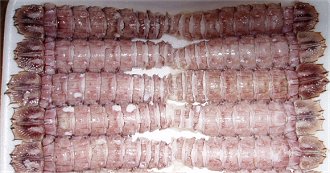
Mantis Shrimp (Squilla) Photographs
and Information
|
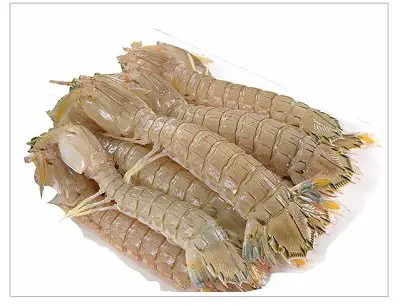
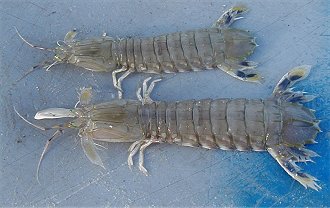
Mantis shrimps or stomatopods are
marine crustaceans, like crabs, rock lobsters and other shrimps, however they
are not a 'shrimp'. Mantis shrimps are highly aggressive crustaceans that
capture prey using large, raptorial claws much like that of a praying mantis.
Also called "shako", "sea locusts" by ancient Assyrians, "prawn killers" in
Australia.
They are very attractive
and beautifully coloured in shades of red, green and blue. There
are two main types of mantis shrimp: 'spearers' and 'smashers'.
Both types strike by rapidly unfolding and swinging the
raptorial claw at the prey. 'Spearers' have a claw lined with
numerous sharp teeth and they hunt by impaling prey on these
teeth. They usually feed on soft-bodied animals like worms,
shrimps and fish. 'Smashers' have a claw shaped like a club,
which they use to smash and hammer their prey. They usually feed
on hard-bodied animals like snails and crabs.
Mantis shrimps play an important role in marine ecosystems,
regulating the numbers of other species and promoting higher
overall species richness. Also, where the seabed is soft, the
burrowing behaviour of mantis shrimps contributes to the
turnover and oxygenation of sediments. Mantis shrimps are also
sensitive to environmental pollutants and are good
bio-indicators of pollution on coral reefs.
|
 |
 |
Did You Know? Mantis Shrimp
are the only animals to have hyperspectral colour vision and are
considered to have the most complex eyes in the animal kingdom. They can see
ultraviolet, visible and infra-red light and different planes of
polarized light. The shape of their eyes allows them to see
things with three different parts of the eye at once.
|
| Scientific Name |
Squilla species |
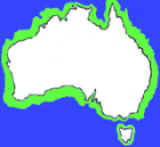
| Location |
Australia wide |
| Season |
All year round |
| Size |
To 30cm |
| Australian Species Code |
- |
| Taste, Texture |
Good eating |
|
Nutritional Information
For every 100 grams raw product
for Mantis Shrimp meat. |
|
Kilojoules |
399 (95
calories) |
|
Cholesterol |
121 mg |
|
Sodium |
185 g |
|
Total fat
(oil) |
0.8 g |
|
Saturated
fat |
36% of total
fat |
|
Monounsaturated fat |
23% of total
fat |
|
Polyunsaturated fat |
41% of total
fat |
|
Omega-3, EPA |
39 mg |
|
Omega-3, DHA |
49 mg |
|
Omega-6, AA |
45 mg |
|
|
Information about Mantis Shrimp
(Squilla):
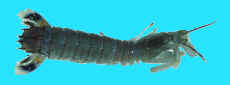 Mantis Shrimp live in a vertical hole in the mud with only the eyes showing. They
snap at small fish in its "preying Mantis-like" arms and drags them into the
hole. Mantis Shrimp live in a vertical hole in the mud with only the eyes showing. They
snap at small fish in its "preying Mantis-like" arms and drags them into the
hole.
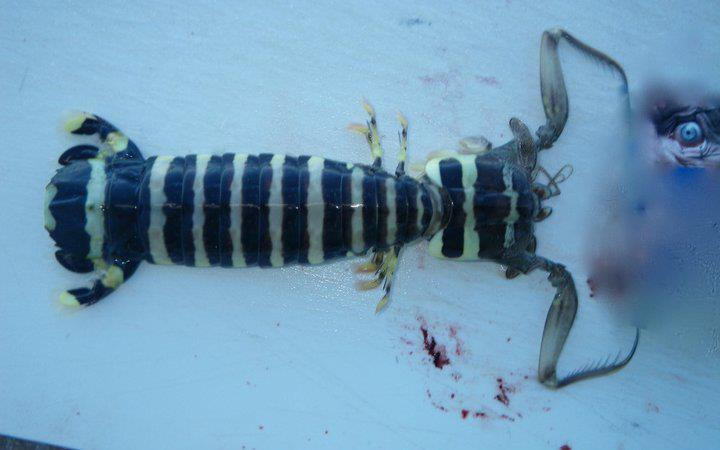
Many different species of
mantis shrimps live in Australian waters. Most of them are less
that 15 centimetres long, but some species reach more than 30
centimetres and would appear quite fearsome to a fish! While
many are pale blue, green or brown in colour, several tropical
species have beautiful colours and patterns, like the one in the
movie. Mantis shrimps have eight pairs of legs (the first five
pairs are equipped with claws) plus modified legs known as
pleopods on their abdomen which are used for swimming. The eyes
and the first pair of antennae are attached to separate movable
segments on the head.
 They
are aggressive predators and feed mainly on small fish, other
crustaceans and molluscs. They use their large second pair of
legs to catch their prey. Depending on the species of mantis
shrimp, this pair of legs is either equipped with spined claws
that are used like spears or hammer-like claws that are used to
batter their target. They strike their prey with acceleration of
up to 23 metres per second. The shock wave from the force can be
enough to stun or even kill the prey. Some larger species with
hammer-like claws have even been known to break the glass of
aquariums. They
are aggressive predators and feed mainly on small fish, other
crustaceans and molluscs. They use their large second pair of
legs to catch their prey. Depending on the species of mantis
shrimp, this pair of legs is either equipped with spined claws
that are used like spears or hammer-like claws that are used to
batter their target. They strike their prey with acceleration of
up to 23 metres per second. The shock wave from the force can be
enough to stun or even kill the prey. Some larger species with
hammer-like claws have even been known to break the glass of
aquariums.
 Females
carry the eggs or lay them in their burrow. After hatching, the
larva initially lives on the seafloor but the first or second
moult it commences a planktonic stage. During this time it looks
very different to the adult. After a few months drifting at sea
it again moults to metamorphose into a burrow-dwelling adult. Females
carry the eggs or lay them in their burrow. After hatching, the
larva initially lives on the seafloor but the first or second
moult it commences a planktonic stage. During this time it looks
very different to the adult. After a few months drifting at sea
it again moults to metamorphose into a burrow-dwelling adult.
About 400 species of
mantis shrimp are known worldwide. Close to 250 species occur in
the Indo-West Pacific region and more than half of these occur
around Australia. New species are regularly being discovered,
even off the coast of New South Wales. Mantis shrimps support
large fisheries in many parts of the world but they are
susceptible to overfishing and habitat loss.
Most species of mantis
shrimp live alone, but there are some species that live in pairs
for life. Mantis shrimps can live in burrows and crevices on
coral reefs, or on the seabed down to a depth of 1500 metres.
Mantis shrimp appear to be
highly intelligent. They are long-lived and exhibit complex
behaviour, such as ritualised fighting
Mantis Shrimp
The eyes of the mantis shrimp are among the most advanced in the animal kingdom.
Human eyes each create a single picture and the two together means that we have
binocular vision. Each one of the Mantis Shrimp eyeballs creates 3 separate
images, a trinocular eyeball, that means the two eyeballs together have
sextocular vision. Human eyes can detect 3 color wavelengths, the mantis shrimp
can detect 12, nine more than we can. They can see colors that we cannot even
see or imagine.
Mantis shrimps are divided into 2 categories, First The Spearers - they have
spiny barbed front scooping claws designed to stab and snag prey. The other is
The Smasher - they have "bowling ball" hands that they use to smash their pray.
They have the fastest punch in the world with the same acceleration as a 22
caliber bullet. The mantis shrimp can deliver a blow with 1500 Newtons of force.
Water moves out of the way so fast that little vacuums are formed called
cavitations bubbles. These bubbles collapse immediately and the force of that
collapse creates a second shockwave and it even generates light and heat.
|
|
Cooking
Mantis Shrimp:
Mantis shrimp can be eaten
raw as sashimi or a sushi topping. Cooked Mantis Shrimp is
similar to lobsters in taste and texture. See
Recipes for Crustaceans - any lobster, shrimp, crayfish,
bugs & crab recipe is suitable for Mantis Shrimp.
How long to cook mantis
shrimp? For 1 kg green (raw) shrimp. Bring 2 1⁄2
litres of water to the boil, add 2 tablespoons of sea salt.
Add shrimp to boiling water. Cook for 3-4 minutes. Shrimp are
done when they float to the top of the water. To test, take out
a shrimp and hold it to the light, it is cooked when the flesh
has shrunk from the shell slightly and the prawn looks
translucent. When they’re done, remove them from the
boiling water and place in a big bowl of iced water to cool
them.
|
|
Commercial Fishing for
Mantis Shrimp:
More links about
Mantis Shrimp
Australian Government - Australian Bureau of Agricultural and Resource Economics
and Sciences (PDF file) - Australian Fisheries Statistics 2010/2011
|
|