|
|
|
|
|
Directory & Info for
Fishing,
Angling, Fishing Tackle, Fishing Guides, Fly Fishing, Bass Fishing,
Sports fishing, Game Fishing....
Info on All types of
Fishing | Angling | Fishing Tackle etc. |
| |
|
Glossary of Fish, Seafood
and Fishing Terms |
|
|
|
Australian Fish Bag Limits and Size Regulations |
|
Photos of Australian Seafood, Fish, Crustaceans &
Cephalopods and Information on each... |
|
Abalone, Blacklip |
|
Albacore
Tuna |
|
Baler Shell |
|
Barbounia, Tiny |
|
Barracouta |
|
Barramundi |
|
Bass, Sea |
|
Batfish |
|
Batfish, Silver |
|
Blackfish |
|
Boarfish |
|
Bonito Tuna |
|
Bonito, Watson's Leaping |
|
Bream |
|
Bream, Butter |
|
Bream, Slate |
|
Bug, Moreton Bay
(Slipper Lobster) |
|
Bug, Balmain |
|
Butterfish |
|
Calamari,
Southern |
|
Carp, European |
|
Catfish, Blue |
|
Catfish, Lesser Salmon |
|
Cockles |
|
Cod, Bar |
|
Cod, Blue eye |
|
Cod, Coral Rock |
|
Cod, Ghost |
|
Cod, Maori |
|
Cod, Murray
|
|
Cod, Southern Rock |
|
Cod, Spotted |
|
Cod, Tomato |
|
Cod, Wirrah |
|
Cod, Yellow Spotted |
|
Coral Trout |
|
Cowanyoung |
|
Crab, Blue Swimmer |
|
Crab, Champagne |
|
Crab, Giant
|
|
Crab, Mud |
|
Crab, Spanner |
|
Crawfish |
|
Cuttlefish |
|
Dart Fish |
|
Dolphin Fish |
|
Dory, John |
|
Dory, Mirror |
|
Dory, Silver
|
|
Drummer, Southern |
|
Eel, Longfin |
|
Emperor, Red |
|
Emperor, Red Throat |
|
Flathead |
|
Flounder, Small Toothed |
|
Flutemouth, Rough |
|
Frost Fish |
|
Garfish |
|
Gemfish |
|
Goatfish |
|
Grouper |
|
Gurnard, Red |
|
Gurnard, Spotted |
|
Hairtail |
|
Hump Headed
Maori Wrasse |
|
Hussar |
|
Jackass Fish |
|
Jacket, Ocean |
|
Jacket, Sea |
|
Jewfish |
|
Jobfish, Gold Banned |
|
Jobfish, Rosy |
|
Kingfish,
Yellowtail |
|
Latchet Fish |
|
Leatherjacket, Reef |
|
Ling |
|
Lobster Eastern
Rock |
|
Lobster Southern Rock |
|
Long Tom |
|
Luderick |
|
Mackeral, Jack |
|
Mackerel, Slimey |
|
Mado |
|
Mahi Mahi |
|
Mangrove Jack |
|
Marlin, Black |
|
Marlin, Blue |
|
Marlin, Striped |
|
Melon Shell |
|
Monkfish |
|
Mono |
|
Moon Fish |
|
Morwong |
|
Morwong, Red |
|
Mullet - Roe |
|
Mullet, Diamond Scale |
|
Mullet, Red |
|
Mullet, Sea |
|
Mullet, Yelloweye |
|
Mulloway |
|
Mussels Black |
|
Mussels Greenlip |
|
Nanygai |
|
Octopus |
|
Orange Roughy |
|
Oreo, Black |
|
Oyster,
Native |
|
Oyster,
Pacific |
|
Oyster, Sydney Rock |
|
Parrot Fish |
|
Parrot Fish (2) |
|
Perch, Ocean |
|
Perch, Saddle Tail Sea |
|
Perch, Silver |
|
Perch, Splendid |
|
Perch, Stripey Sea |
|
Pig Fish |
|
Pike |
|
Pineapple Fish |
|
Prawn, Banana |
|
Prawn, King |
|
Prawn, Red Spot |
|
Prawn, School |
|
Prawn, Tiger |
|
Queenfish, Needleskin |
|
Rainbow Runner |
|
Redclaw Crayfish |
|
Redfish |
|
Ribaldo |
|
Ribbon Fish |
|
Rudder Fish |
|
Salmon, Atlantic |
|
Salmon, Australian |
|
Scad |
|
Scallops, Queensland |
|
Scallops, Tasmanian |
|
Scorpion Fish, Raggy |
|
Shark |
|
Shark Black Tip |
|
Shark, Blue |
|
Shark Bronze Whaler (Dusky) |
|
Shark, Bull |
|
Sharks Fins |
|
Shark, Gummy |
|
Shark, Mako |
|
Shark, School |
|
Shark,
Tiger |
|
Shark,
Whiskery Reef |
|
Shark, White |
|
Shrimp, Mantis |
|
Sicklefish |
|
Silver Biddy |
|
Snapper |
|
Snapper, Big Eye |
|
Snapper, Fry Pan |
|
Snapper, Gold Band |
|
Snapper, King |
|
Snapper,
Red |
|
Snapper, Red Tropical |
|
Sole |
|
Sole, Tongue |
|
Squid, Arrow |
|
Squirrel Fish |
|
Stargazer |
|
Stingray, Butterfly |
|
Stripey Sea
Perch |
|
Surgeonfish, Sixplate Sawtail |
|
Sweetlip, Slatey |
|
Sweetlip, Yellow |
|
Swordfish |
|
Tailor |
|
Tarwhine |
|
Tilefish,
Pink |
|
Trevally, Big Eye |
|
Trevally, Golden |
|
Trevally, Silver |
|
Triple Tail |
|
Trout |
|
Trumpeter, Striped |
|
Tuna,
Albacore |
|
Tuna, Bigeye |
|
Tuna, Bluefin |
|
Tuna, Longtail |
|
Tuna, Skipjack |
|
Tuna, Striped |
|
Tuna, Mackerel |
|
Tuna, Yellowfin |
|
Venus Tusk Fish |
|
Whiting, Sand |
|
Whiting, School |
|
Wrasse |
|
Yabby,
Freshwater Crayfish |
|
Yellowtail |
|
FULL LIST of Fish &
Seafood |
|
Beche De Mer
(Sea Cucumber - Trepang) |
|
Amberfish |
|
Blackfish |
|
Black Teatfish |
|
Brown Sandfish |
|
Curryfish |
|
Elephants Trunks fish |
|
Greenfish |
|
Lollyfish |
|
Pinkfish |
|
Prickly Redfish |
|
Sandfish |
|
Stonefish |
|
Surf Redfish |
|
White Teatfish |
|
|
|
Commercial
Seafood Directory |
|
Sea-Ex Seafood, Fishing, Marine
Directory |
|
Aquaculture Directory |
|
Commercial Fishing |
|
Seafood Information by
Country |
|
Australian Fish Photos &
Info |
|
Interesting Fish Facts & Trivia |
|
Country Directories |
|
Thailand Business
Directory |
|
Seafood: |
|
Wholesale Seafood
Suppliers Australia |
|
Wholesale Seafood
Suppliers International |
|
Retail Seafood Sales |
|
Seafood Restaurants |
|
Seafood Recipes |
|
Seafood Information |
|
Seafood
Industry Resources |
|
Information about Blacklip Abalone (Haliotis rubra)
Abalone is an edible mollusc. Endemic to
Australia. It is considered a delicacy. It has a single, ear-shaped
shell lined with mother of pearl. The foot of the abalone has a distinct
black lip that gives this species its name. Belonging to the family of molluscs,
abalone are large marine snails or gastropods with a hard ear-shaped shell and a
muscular foot which inhabit Australia's rocky shorelines, from shallow water up
to depths of forty or sometimes 50 metres.
|
Abalone is found along the rocky shores of
Australia, south from mid New South Wales down and around to Western Australia.
Abalone in shallow waters averages around 8cm, while shells found in deeper
water grow to around 14cm. Growth rates vary seasonally and with location.
Blacklip abalone can grow to at least 21cm in length.
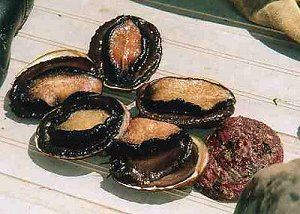
Blacklip Abalone graze on seagrass leaves and
algae growing on rocks, their diet is dominated by red algae. They are
preyed upon by crabs, starfish,
stingrays, wobbegong sharks and possibly
rock
lobsters. Abalone eat marine algae. The adults feed on loose pieces drifting
with the surge or current.
Also known as Brownlip Abalone.
State regulations set bag limits and minimum size
limits for abalone caught by recreational fishers. In Western Australia
abalone may only be taken by divers using snorkelling gear.
Of over 100 species of
abalone living in the world today, at least twenty three of
these occur in Australia: however in Tasmania it is only the
two largest species which form the basis of the commercial
abalone fishing industry - the green lip (Haliotis Laevigata)
and the black lip (Haliotis Ruber).
Abalone adheres itself to rocks, so a tool called
an "abiron" is used to dislodge it. An ab-iron is similar to a paint
scraper. See below:
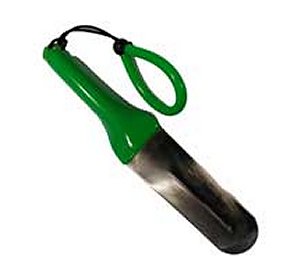
Abalone Iron | Ab Iron
Used for prising Abalone from rocks.
|
 |
 |
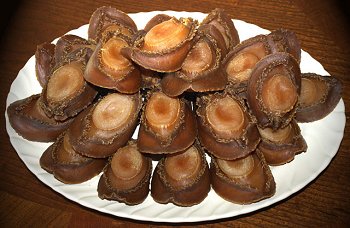
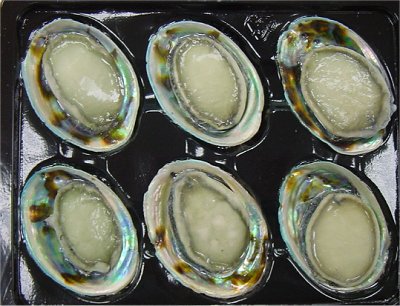
L&B Taspac - New
Zealand Seafood
|
| Scientific Name |
Haliotis rubra |
| Location |
Southern half of Australia |
| Season |
- |
| Size |
To 21 cm in length. |
| Australian Species Code |
00 662001 |
| Taste, Texture |
Delicate taste, firm texture. |
.
|
Nutritional Information
For every 100 grams raw product
of Blacklip Abalone |
|
Kilojoules |
- |
|
Cholesterol |
- |
|
Sodium |
- |
|
Total fat (oil) |
0.8
g |
|
Saturated fat |
31%
of total fat |
|
Monounsaturated fat |
22%
of total fat |
|
Polyunsaturated fat |
47%
of total fat |
|
Omega-3, EPA |
48 mg |
|
Omega-3, DHA |
2 mg |
|
Omega-6, AA |
100
mg |
|
Other
Abalone Links:
ABALONE RECIPES
More information about Abalone
Recipes using Abalone - from How to Cook Fish.info
Instructions on preparing abalone western style
-
Step by Step photos
|
Habits of Abalone
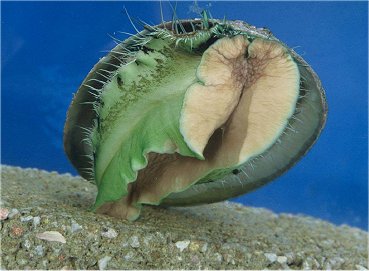
In their natural habitat abalones are browsers, moving along
in a mainly uninterrupted gliding motion aided in their
locomotion by the creeping sole of their muscular foot. As
light evading animals abalone attach themselves to shady
parts of rocks with this foot which has a suction force of
more than 4000 times that of their own body weight. Haliotids
are herbivores, feeding almost solely upon algae and small
sea weeds which they grind from the rocks. Never travelling
far from the place where they first settled, abalone usually
prefer to dwell in places on the seabed where drift weed is
conveniently carried along by a gentle current. Seaweed, bryozoa and sponge form a covering on the outer shell of the
abalone, providing it with handy camouflage.
Life Cycle of Abalone
Abalones are either male or female but lacking accessory
reproductive organs necessary for copulation, they are
spawners. An adult female may lay up to 500,000 eggs which
are released into the sea water when induced by the presence
of male sperm. Fertilisation takes place in the sea and the
eggs then float for one to five days as they develop into
veligers with a minute shell. The veligers sink to the sea
bed attaching themselves to lithothamnion, a red sea weed
covering rock, and begin to grow at a rapid rate. Growth
rates depend entirely on the food supply available but it
can be as much as 40 millimetres per year.
Young abalone remain
vulnerable to natural predators, making a tasty dish to many
varieties of fish and crabs. As such they live by day
concealing themselves within tiny crevices between rocks
emerging only at night to feed. Yet as they grow larger and
become more sexually mature (about three years of age) they
may remain out in the open while still avoiding the
occasional deadly foe such as octopus, crabs, fish, sharks,
stingrays and of course man.
|
|
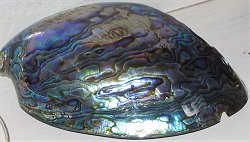 Abalone Shells Abalone Shells
Abalone
shells, which can attain
lengths of up to twenty centimetres, are flat, asymmetrical
(ear-shaped) and spirally coiled with a low spire and a row
of open holes on a curved line along one edge.
Cooking Abalone:
Abalones (Family Haliotidae) have
succulent meaty bodies and are both
delicate and delicious in flavour placing them in high
demand on dinner tables across the globe.
 Commercial Fishing for Abalone: Commercial Fishing for Abalone:
Abalone is an important
commercial fishery.
Experimental aquaculture is being tested in Australia in Tasmania, South Australia and
Victoria.
Abalone is one of the most prized sea
delicacies worldwide. Farming of abalone began in the late
1950's and early 1960's in Japan and China.
The blacklip abalone (Haliotis
rubra) forms the basis of the abalone fishery in NSW.
Abalone are commercially harvested from rocky reefs by
divers typically using surface-supplied air or scuba. In
practice, most commercial abalone fishing takes place on the
south coast of NSW, primarily from Jervis Bay to the
Victorian border, with most abalone found close to the
shore.
|
|