Sea-Ex Seafood
Trade Directory
Directory of Seafood
Companies by Species
Imported, Exported, Wholesale, Processors &
Producers
Click Here for
SEAFOOD DIRECTORY
Pacific Oyster - (Crassostrea
gigas) Photographs
and Information
Oysters have always been linked with
love. When Aphrodite, the Greek
goddess of love, sprang forth from the
sea on an oyster shell and promptly gave
birth to Eros, the word "aphrodisiac"
was born.
Why are Oysters the Food of Love?
Oysters are rich in vitamins and
minerals, especially zinc, which is
implicated in the production of
testosterone. They are also a source of
dopamine, which amplifies the intensity
of sensation. Serve Oysters on
Valentine's
Day!
Other common names: Pacific king oyster, Pacific
rock oyster
Pacific oysters are endemic to Japan, but have
been introduced into a number of other countries including
Australia. Most of these introductions have been for the purposes of
aquaculture, with Pacific oysters the most widely cultured shellfish
species worldwide.
Pacific oysters were first introduced into
south-eastern and western Australian waters for aquaculture. They
later found their way into NSW waters, where they have spread and
invaded intertidal habitats of many waterways.
Pacific oysters are a hardy species with fast
growth and high reproductive rates. This has allowed them to
establish dense populations in some areas, often displacing native
intertidal species.
Although Pacific oysters are the basis of an
important aquaculture industry in Port Stephens, elsewhere they have
caused significant problems for oyster farmers who culture native
Sydney rock oysters (Saccostrea glomerata). As the two species live
and spawn in the same locations, Pacific oysters can settle on and
(due to their faster growth rate) smother farmed Sydney rock
oysters.
Pacific oysters are plankton feeders that filter
minute marine algae and other microorganisms out of the water.
Scientific Name
Crassostrea gigas
Location
-
Season
-
Size
-
Australian Species Code
-
Taste, Texture
-
Did you know?Pacific oysters can live up to 10 years and
reach an average size of 150-200 mm.
Did you know? A group of oysters is
called a "bed"
Nutritional Information
For every 100 grams raw product
for Oyster fillet.
Kilojoules
378 (90
calories)
Protein
11.1 g
Cholesterol
27 mg
Sodium
106 mg
Total fat
(oil)
1.0 g
Saturated
fat
30% of total
fat
Monounsaturated fat
13% of total
fat
Polyunsaturated fat
57% of total
fat
Omega-3, EPA
136 mg
Omega-3, DHA
142 mg
Omega-6, AA
30 mg
POMS - Pacific Oyster
Mortality Syndrome
What is POMS?
Pacific Oyster Mortality Syndrome only affects Pacific Oysters. It
is a virus (OsHV-1 micro variant) that kills the oyster within hours. It
can wipe out an entire oyster colony in less than 36 hours.
Does POMS affect all oysters?
No, Pacific Oyster Mortality Syndrome only affects Pacific Oysters (Crassostrea
gigas) it does not affect Sydney Rock Oysters (Saccostrea
commercialis), or Australian Native Oysters (Ostrea
angasi).
How does
POMS kill Pacific Oysters? Oysters are Bi-valves with 2 shells. The POMS virus weakens the
oyster causing the valves to open. They die within a few hours. POMS causes 100%
mortality in juvenile Pacific Oysters (called spats)
Where is POMS in Australia?
POMS (Pacific Oyster Mortality Syndrome) was first discovered in the
Georges River (NSW) in November 2010. Three months later it had spread to the
Parramatta River, west of Sydney, NSW. In January 2013, it was found in Pacific
Oysters in the Hawkesbury River, north of Sydney, NSW. Now, in early February,
2016, the virus has been detected in Tasmania.
Where else is Pacific Oyster Mortality
Syndrome found? POMS was first found in France in 2008. The virus is now found in
Spain, the Netherlands, Denmark and New Zealand.
Can Humans catch POMS?
No, POMS is not transmittable to humans.
NATURAL DISTRIBUTION AND BIOLOGY
OF THE PACIFIC OYSTER (Crassostrea gigas)
Pacific oysters are bivalve molluscs belonging
to the family Ostreidae. They are native to northeast Asia
(including Japan), but have been translocated and spread widely
throughout many countries (including the UK, France, USA, Canada,
Korea, China and New Zealand) for the purpose of aquaculture.
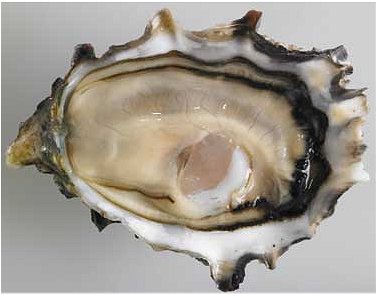
Pacific oysters have a fairly thin shell with no
hinge teeth on the inner, upper shell (unlike Sydney rock oysters).
The adductor muscle (which holds the two shells together) is purple
or brown in colour, whilst the edges of the mantle (the tissue which
secretes and lines the shell) are black.
Adult Pacific oysters
are sessile and will
settle on any hard substrate in the inter-tidal and shallow subtidal
zones, to a depth of about 3 metres. They favour brackish waters in
sheltered estuaries, although they tolerate a wide range of
salinities and water quality and can also occur offshore.
Pacific oysters have very high growth rates
(they can grow to over 75 mm in their first 18 months) and high
rates of reproduction.
Like most
oyster species, Pacific oysters change
sex during their life, usually spawning first as a male and
subsequently as a female. Spawning is temperature dependent and
occurs in the summer months. Pacific oyster females can produce
between 30 to 40 million eggs per spawning, often giving the
surrounding water a milky appearance. Fertilisation takes place in
the water column.
The larvae are planktonic and free swimming,
developing for three to four weeks before finding a suitable clean
hard surface to settle on. Although they usually attach to rocks,
they can also settle in muddy or sandy areas (where they attach to
small stones, shell fragments or other debris) or on top of other
adult oysters. A very small percentage of oysters survive this
phase; those that do are called "spat".
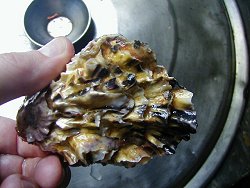
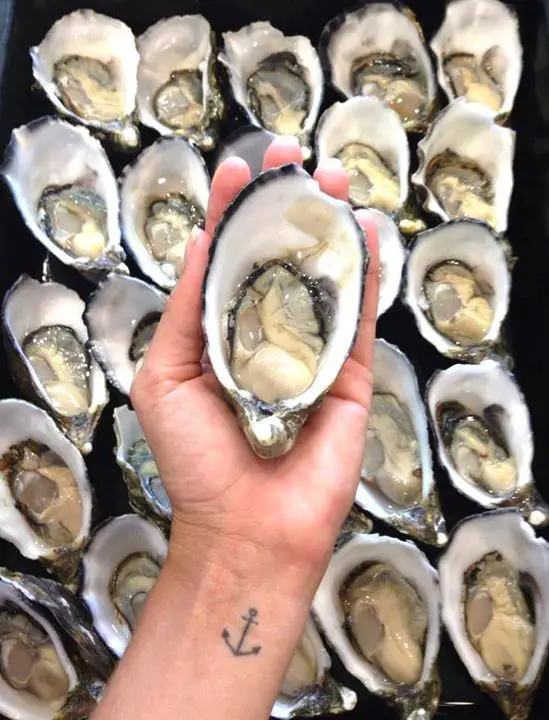
Pacific Oyster Shell Top
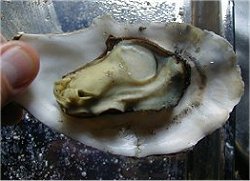
Pacific Oyster Opened
-
-
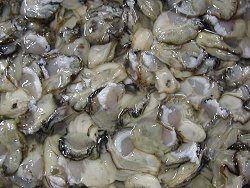
Pacific Oyster Meats
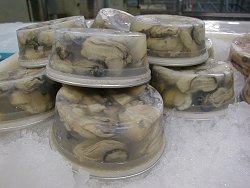
Pasteurised Pacific Oysters
in Juice
CookingPacific
Oysters:
Oysters have a strong,
rich and distinctive flavour and a soft, silky texture. They
are often served raw, but deep frying, shallow frying and
grilling are also popular. Pacific oysters are particularly
good in pies.
The key to not overcooking oysters is to ensure that cooking
stops as soon as the edges of the meat start to curl.
Raw or au naturel oyster can create precious portions such
as: with lemon juice and cracked pepper; topped with tabasco
sauce, tomato, garlic and cream; in the famous Bloody Mary
tomato juice spiced with vodka; swimming in a sauce of lime,
ginger and shallots; or Stuart Prosser's tartare, which
incorporates horseradish and creme fraeche.
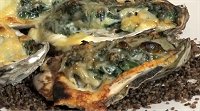
Grilled oysters can be tantalisingly topped with: the
traditional Kilpatrick; fresh herbs and breadcrumbs; or
balsamic vinegar and roasted capsicum.
Deep fried oysters in batter can be served with basil, aioli
or spicy soy dressings (an appetising additive to warm
salads).
Alternatively, try blending oysters with bechamel and serve
in bread or pastry cups for hors doeuvres, or include them
in soups and bisques.
Bottled oysters can be used in cooked dishes such as soups,
terrines and braised dishes.
Opening
(Shucking) Oysters: Scrub
the Oysters under running water to clean shells. Place
Oyster, flat side up, on a board and press onto end opposite
hinge using a cloth to protect hand. Insert tip of oyster
knife next to hinge, push firmly against hinge and pry the
shells apart, sliding the knife against the inside of the
top shell to sever the muscle holding the shell together.
Discard top shell, rinse Oyster in bottom shell lightly in a
bowl of cold water to remove shell fragments and grit. With
Oyster knife, loosen Oyster from bottom shell and turn it
over for good presentation.
How to shuck an
Oyster
Sydney Fish Market takes you through how to tell the
difference between a Sydney Rock Oyster and a Pacific
Oyster, what to look for, how to prepare and store them. Not
to mention how to shuck your own!
Store live oysters,
clams and
mussels in the refrigerator. Keep damp by placing in
shallow bowl with a wet paper towel draped over them. Don't
store an oyster on its side. Every so often, it will relax
and open up a bit. If it's sitting on its side, it could
lose all its liquid which is vital for flavour.
Keep fresh shucked oysters,
scallops and clams in their own container and store in the
refrigerator. For best results, surround the container with
ice.
They are farmed in Tasmania and South
Australia and in Port Stephens in New South Wales. In South Australia, the
total direct business turnover of oyster farming was almost $31 million in
2002/03. Of this, $16.1 million was from the farm gate and the rest from
processing, transport, retail and food service industries. 320 people were
directly employed in oyster farming. Most of the oysters are grown in Coffin
Bay, north-west of Port Lincoln.
Pacific Oyster hatcheries are built on land. Sexually mature oysters spawn in
the hatchery then
the larvae and spat are grown until they reach a size suitable for on-growing in
a nursery site. As well, the hatcheries need to grow large amount of different
types of microalgae to feed the developing oysters.
As the oysters grow they settle crushed shells, then sieves are used to remove
them from the tanks and they are moved to indoor nursery tanks. Once the spat
reach 3 to 15mm in length they are sold to farmers for on-growing in intertidal
or subtidal sites.
There are a number of methods for growing the spat. These include:
Intertidal racks and baskets Rectangular shaped baskets, made from tough polypropylene mesh, are attached
to the
racks by two 1m long wooden sticks (approximately ). The racks are made of
wooden
posts (uprights) which are drilled vertically into the seabed to provide
support. Attached to these are more wooden posts which run parallel to the
seabed and hold up the baskets
Intertidal racks and trays Instead of baskets, trays are used. These provide greater protection for the
growing oysters. The trays are made of wooden frames with mesh covering attached
to the racks.
Intertidal Long-lines In this method, ;onglines and bags are used to on-grow oysters. The bags are
made of polypropylene mesh; cylindrical in shape, 90cm length x 15cm diameter,
and hung on a wire suspended by wooden uprights. The height of the wire can be
adjusted so the oyster bags can be lowered or raised depending on the tide.
Subtidal Long-lines
In some parts of SA, farmers have access to sub-tidal sites where sub-surface or
surface
longlines are used to suspend a series of stacked trays (approximately 1.5 x
1.5m). These
longlines are attached to the sea-bed and supported by buoys.




 Adult Pacific oysters
are sessile and will
settle on any hard substrate in the inter-tidal and shallow subtidal
zones, to a depth of about 3 metres. They favour brackish waters in
sheltered estuaries, although they tolerate a wide range of
salinities and water quality and can also occur offshore.
Adult Pacific oysters
are sessile and will
settle on any hard substrate in the inter-tidal and shallow subtidal
zones, to a depth of about 3 metres. They favour brackish waters in
sheltered estuaries, although they tolerate a wide range of
salinities and water quality and can also occur offshore.